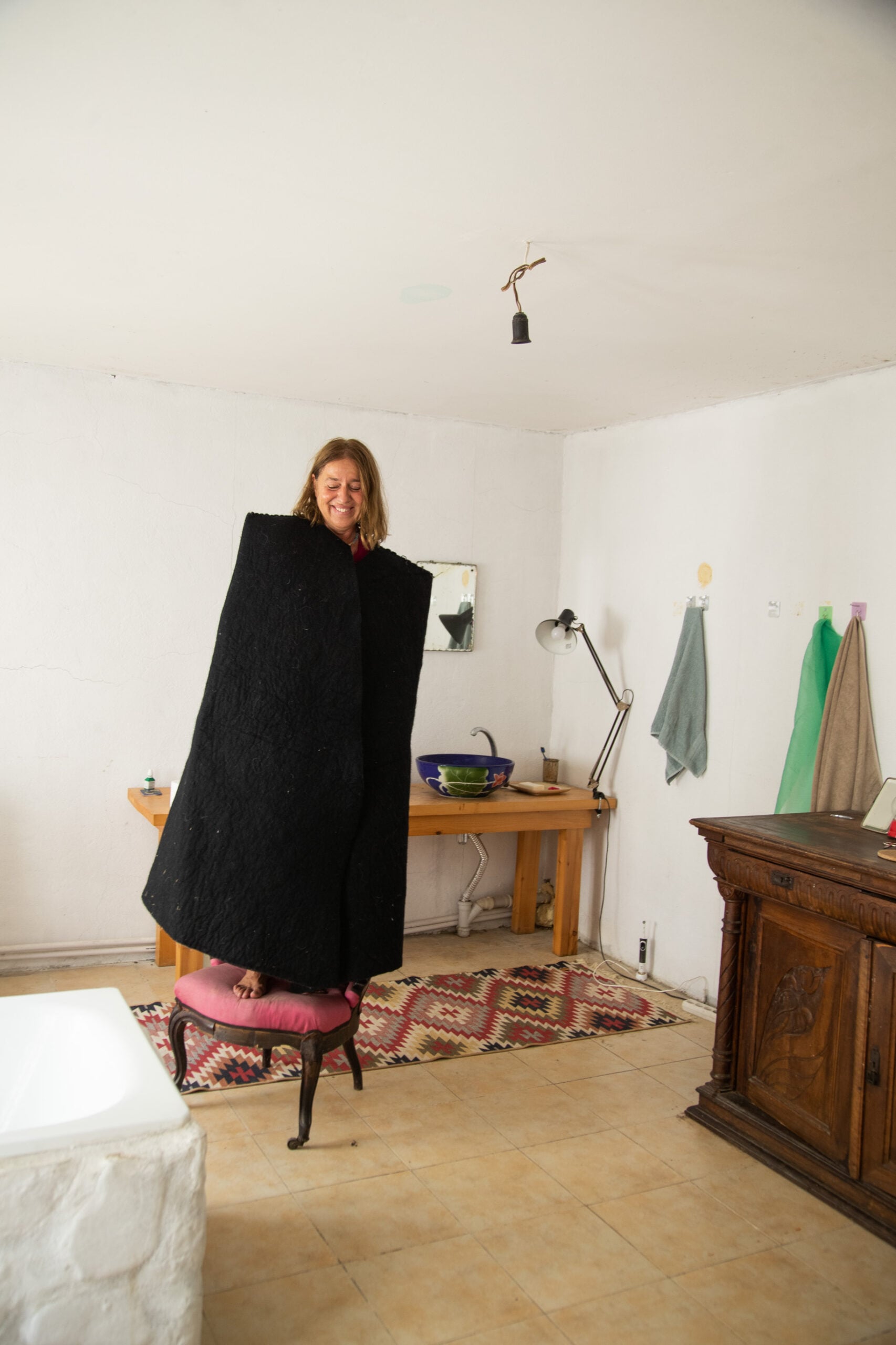
Could give us a quick description of what’s on here today?
The project that I’ve done with Prada is called Chawan Cabinet, and the brief was very simple—to help Prada think about the philosophies and ideologies that govern how we think about domestic life and domestic things. Rather than starting with a cup or a bowl, I decided to start with Japanese philosophy, Japanese architecture. I asked friends of mine if they could help me think through tea ceremony, through incense ceremony, through private discourse, asking ‘How do you guys think about home?’
Because my training is in Japanese ceramics, I was able to bring these aesthetic intentions to the space and—working with a really great architect, Seiichiro Takeuchi—we were able to conceive of this unbelievable space.
I wanted to introduce a body of work that represented and reflected my 22-year-long relationship with the town Tokoname. Then I wanted to think about how that relationship with Tokoname could connect to my relationship with Miuccia, and the ways in which those relationships together might make some new beautiful objects.
The exhibition seems to have technically more complex pieces, contrasting with, on a technical basis, less complex pieces.
A couple things started to happen as we assembled. What should be on the shelves in the space? I thought we should have a combination of objects that represent precision and maybe even manufacturing—a manufactured good still touched by the hand but with a kind of industrial touch, hence we introduced objects that are made in both Japan and Germany. Then we would have a set of objects that were technically excellent but absolutely made by hand. So you have examples of oribe, which is a kind of green glaze complemented by very intense inlay and design, made by my dear friend Shion Tabata—the work is beautiful. Then there’s work by another friend, Taira Kuroki—a sake vessel and these pouring glasses. This sake vessel has to be the lightest white stoneware I’ve ever touched in my life—it feels like you’re not holding anything.
We wanted to then complement that with my favourite works which are Mingei-style works. These works are intentionally a little bit heavier, seemingly more provincial—maybe slightly bigger than they need to be—but the hope is that these are objects that were made by everyday people with no real pretence for ceremony or decoration. In some cases, they’re simply making a totally functional thing, and the aesthetic intention is secondary to its function. The fact that there’s beauty is not to say that there’s no consciousness of it, but that there’s no self-consciousness of it. Whatever the outcome is, it’s a byproduct of just needing something to drink out of or eat on.
I love that balance between an intentional display of ornamentation and then an intentional refusal of ornamentation. What happens if you put these things on the same shelf? I think it’s a much more exciting shelf if you have a manufactured object next to something that looks like a rock but is actually used to hold a scoop or a spoon.
In this way, it gives us a chance to examine what feels good on a table, what feels good in a room. And I like that very much.
I read the word ‘edition’ in the text in reference to the manufactured objects, and it struck me almost as a mistake because I thought, ‘These can’t be editions because they don’t feel at all manufactured. It feels like the human hand has been involved in every step’. Can you tell me more about the manufacturing side?
One of the real challenges that we had was to figure out how to label things. If we only made 50 tea bowls, we wanted to find a way to tell people that we only had 50. The word ‘edition’ is used because we were stumbling between the language of a gift culture that I have at my studio and that of a retail project which will ultimately pay for the creation of this space.
That tension is one that I’m not running away from—I’m kind of leaning into it. If the retail team says, ‘How many of these are we selling?’, the answer is not ‘an unlimited number’. They want to know when they’re at 37 because there’s only 13 left.
In that sense, phrases like ‘this is a single artistic object’ or ‘this is one-of-five’ or ‘we don’t have the ability to make this thing because this kiln no longer exists’ give clues to the fact that something is not infinitely reproducible. There might be some things that are seemingly more reproducible, but I love that I could only make as many as I could make before the start date.