
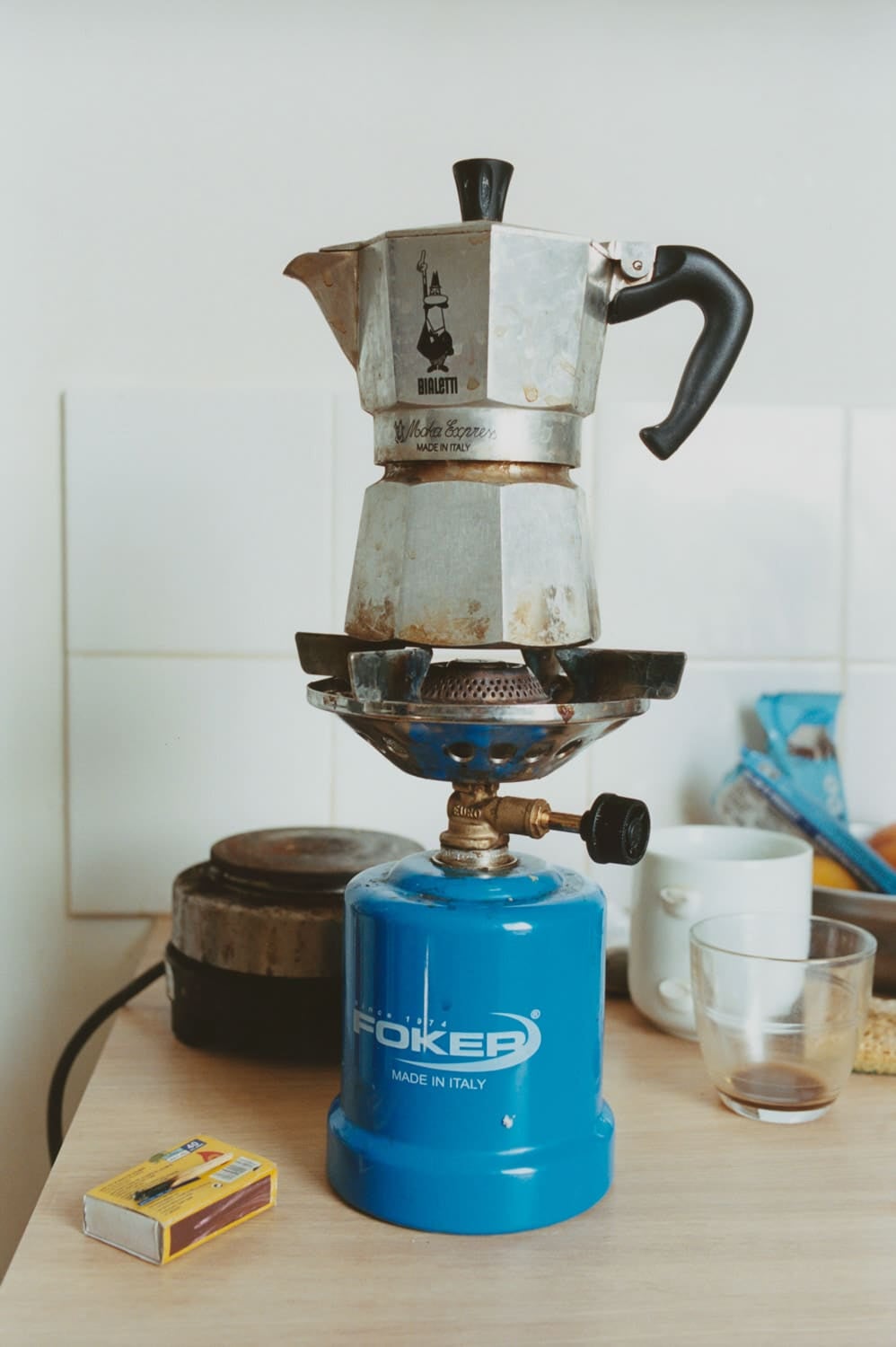
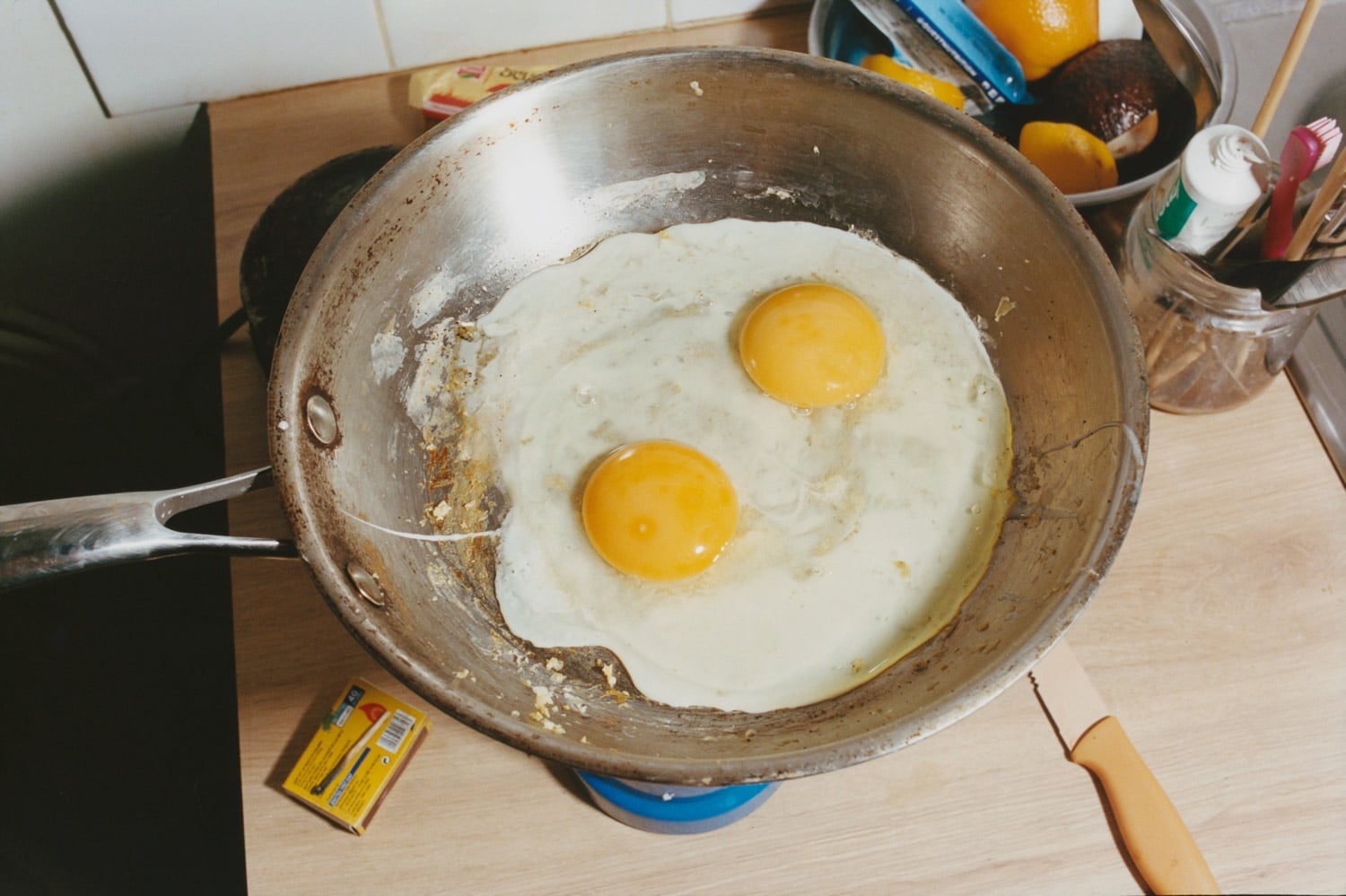
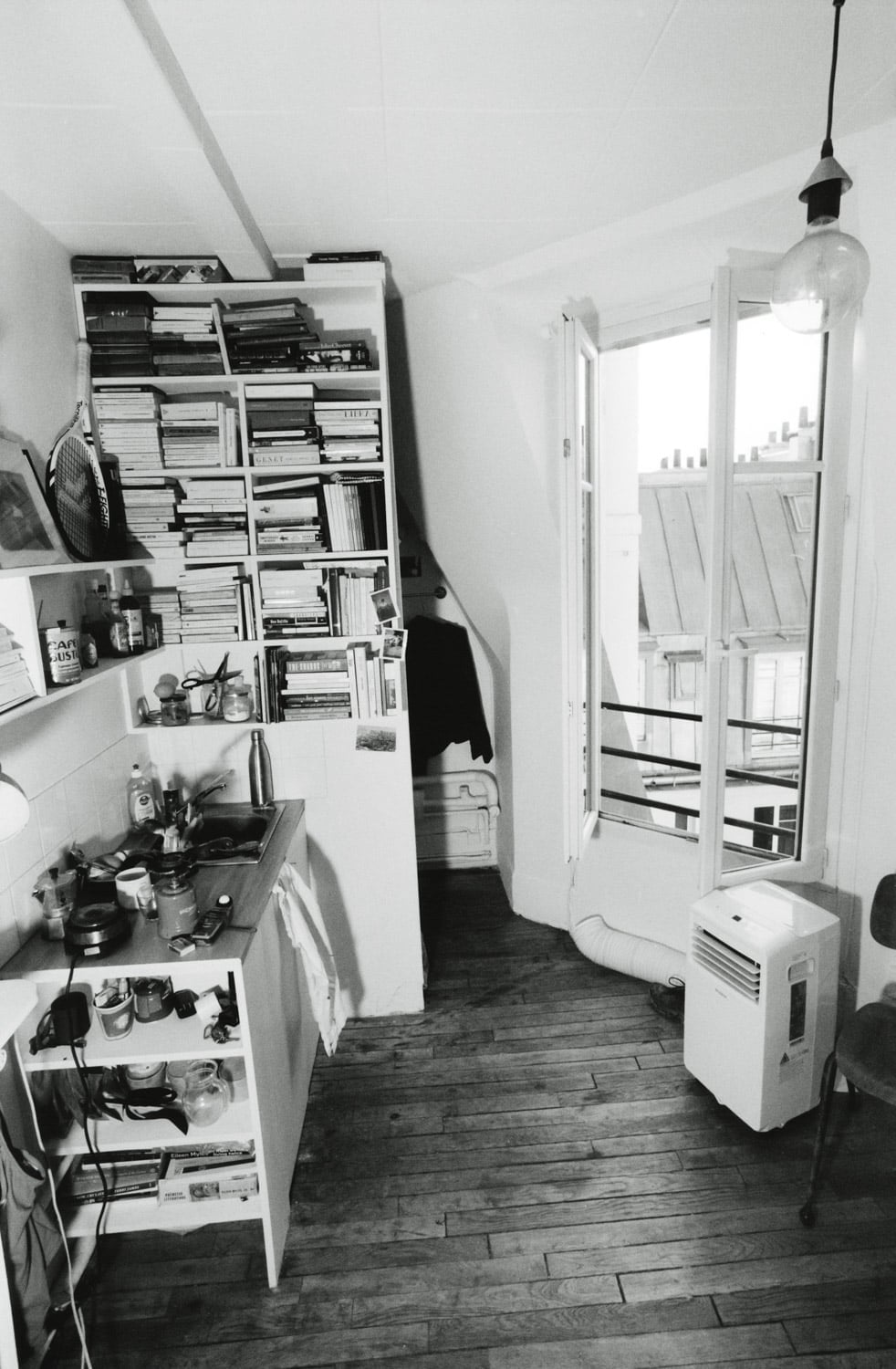
Paris: Debré invites me to her home for the interview and asks me to send a WhatsApp message as soon as I arrive, so she can come down to get me. I set down the watermelon that I’ve brought as a gift. As I fish my phone out of my handbag to let her know I’m downstairs, I see her coming up the same hill I’ve just walked up myself. The first thing I notice is Constance Debré’s smile—open and sincere. We greet each other on the trottoir in front of her building, an unusual one for Paris, reminding me of the Art Deco houses in Miami Beach on Collins Avenue. With rounded shapes, wide glass doors, and a mirror-lined hallway, it has a flooring of tiles or stones that I can’t identify at first—but I notice it has been laid in a beautiful pattern. She offers to help with the watermelon. We walk down the hallway into a small, glass elevator. Debré holds the door for me and tells me how she finally committed to a room of one’s own. She bought it. It belongs to her. It is, literally, one room. To the left of the door is a sink; above it is a bookshelf with a few books, some kitchen utensils, a tennis racket. She’s playing tennis again. Only one window, opposite the bookshelf. It’s open, with a view to a patch of blue sky, white facades, and tin roofs. Next to the window is a bed, next to the bed a writing desk—and we are back at the door. No shower? No bathtub? ‘No. But fortunately the plumbing connections were here, so I installed a toilet. It’s all I need. I shower at the pool. I swim every day anyway’, says Debré. She turns towards her bookshelf and reaches for the small Bialetti to make coffee. Striking a match, Debré lights the little gas stove on the counter next to the sink, then cuts the watermelon. When everything is ready and set up on her writing desk, the only desk in the room, she sits on the bed, leans against the wall, and laughs: ‘You know, it’s funny that you wanted to interview me on Bastille Day. The first time I kissed a woman was on Bastille Day, 10 years ago—not that long ago actually. First kiss, first sex’. What follows is a conversation based on Debré’s own words, sentences taken from her trailblazing works, Playboy, Love Me Tender, and Name, in which a woman in her mid 40s—a mother, lawyer, wife—decides to give up her marriage, her career, and even loses custody of her child in her quest to live exactly as she wishes, as a lesbian writer.
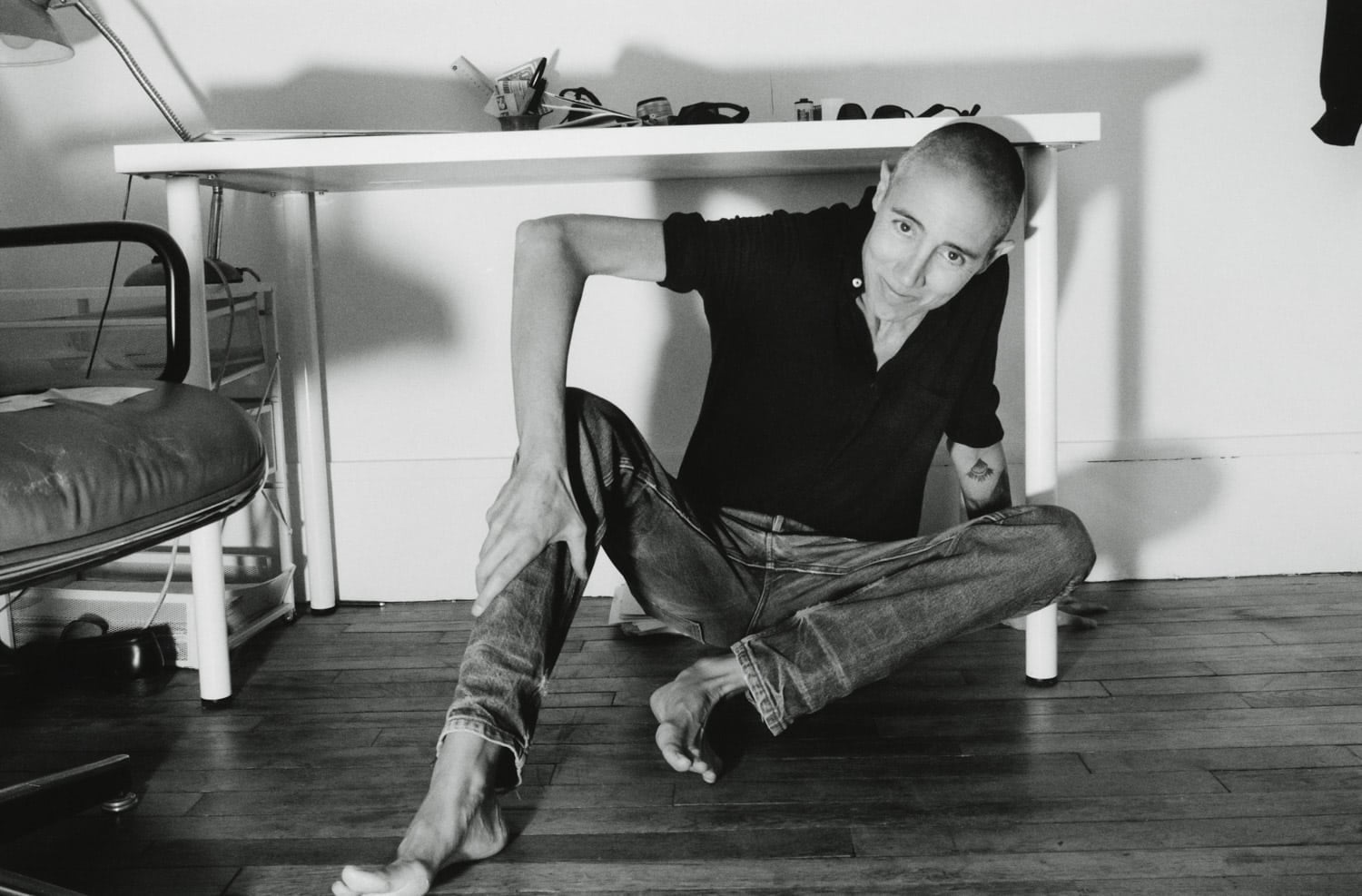
A conversation with Constance Debré for Apartamento magazine issue #38

‘They text me when they arrive and I go down to open the door, I haven’t given them the code to get into the building’.
In Love Me Tender you don’t give any of your lovers the door code because, once someone knows the building’s entry code, they can show up at your apartment door anytime. You did the same to me.
But for another reason. In this building there is a second door. With the code you can get only through the first door. The second works with a buzzer, but there is no connection to my room; I can’t open the second door from up here; I have to go down.
‘How is it possible to be so fucking bored’.
You broke with all conventions and are living the life you want to live. Do you still feel bored sometimes?
I think boredom is always the starting point. I wouldn’t trust anyone who isn’t, again and again, going through boredom. It’s a state where you develop the freedom to invent things; that’s how you fight boredom. Once you acknowledge boredom and you say to yourself, ‘I’m not going to accept this, I’m going to find my own way’, boredom leads you to questions. What should I do? What do I want to do with myself? The latter, to me, is the most existential and interesting question.
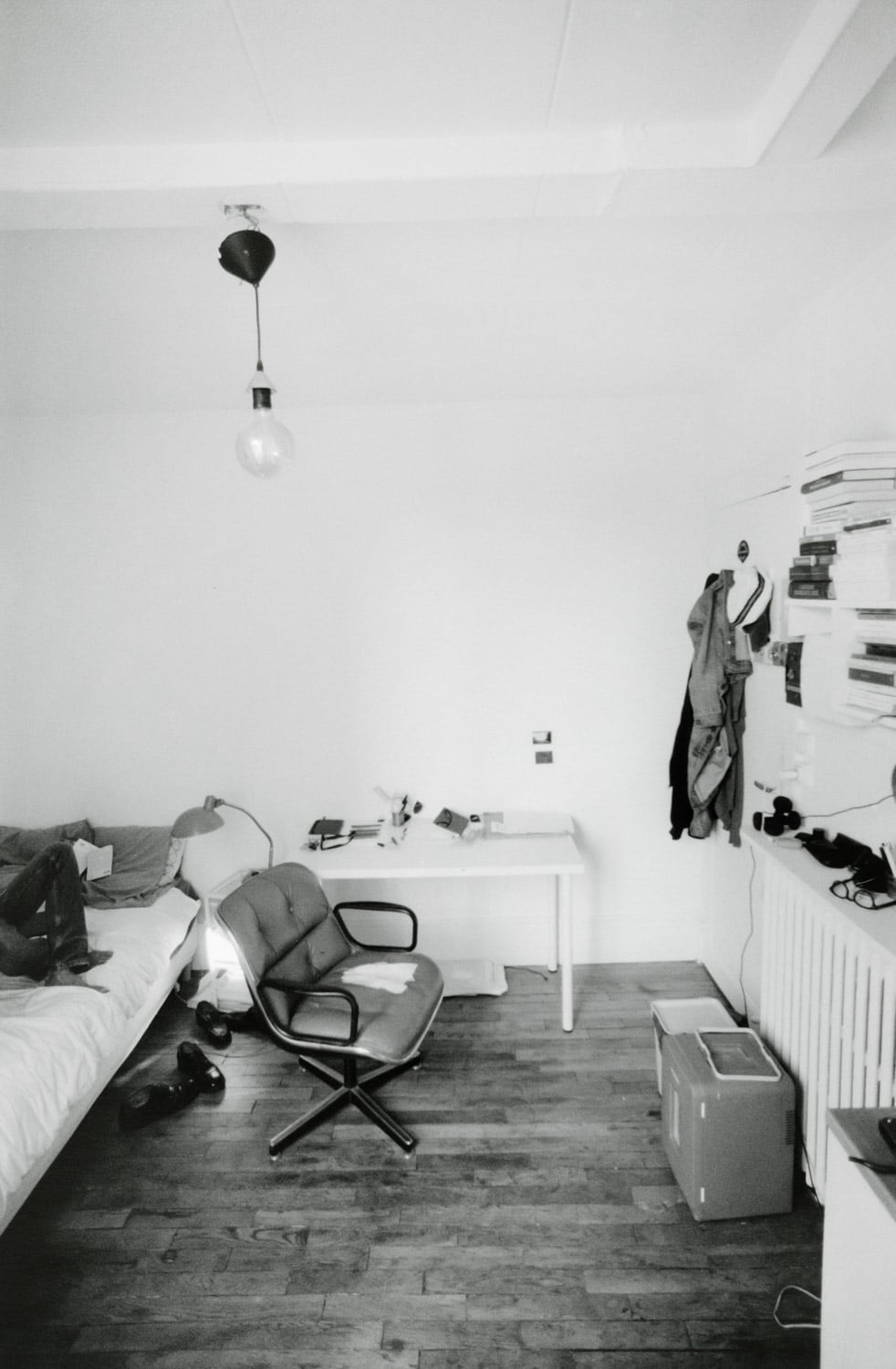
‘I threw everything out. Everything but two bags that I took on the back of my scooter’.
Is there anything in this room from those two bags?
I’m not sure anything survived. I don’t care about things; I am not attached to things. If all of this burnt down, I wouldn’t miss anything. Even my notes—I do write things on paper, but I never look back at them. I do it only to calm down in the moment.
‘I got my Rolex back’.
Throughout the three books you mention your Rolex a few times, pointing out how you need nothing, how you keep nothing, except your Rolex.
A Rolex is so strongly associated with bad taste, wealth, and vulgarity that I thought it was funny to have it, and funny to put it in the book, when I was really living off 15 euros a day. By the way, it was an old, kind of shitty Rolex, not an expensive one. I bought it for myself when I was 18. But I sold it; I’ve got this digital Casio now. At some point I found it ridiculous. I could make 1,000 euros out of the watch, so I sold it. In the book I didn’t pawn my Rolex; a girl took it.

‘Breasts and love… desire makes everything so easy, there is no awkwardness, nothing strange about the movements I’m making’.
In ‘Letter from a Trans Man to the Old Sexual Regime’, Paul B. Preciado addresses the politics of gender, violence, and desire. Preciado proposes, ‘We must learn how to desire sexual freedom’. I came out when I was 16 for exactly this reason: I desired sexual freedom. Your books tell of the consequences of acting on one’s desire.
I don’t especially relate to Preciado’s work. I don’t relate to people saying that a certain form of sexuality is freer than another. I don’t see homosexuality as freer or better than heterosexuality. I don’t even identify as homosexual, or I don’t care about those things. I’ve had heterosexual relationships and homosexual relationships; it’s not an identity. My only identity is my work. And even when I use the first person, it’s never about me; it’s fiction. I’m not sure what my first three, of five, books are about. I think they’re very different from one another, but I think I just put a character in a plot of events and conflicts and tried to move this character in a specific and maybe unusual way. For instance, Playboy, my first book, deals with a character who, like me, becomes gay at 40 something. But, as opposed to those stupid coming-out books or stories we read everywhere, I wanted the book to say that it doesn’t change anything. It’s just a bunch of events you have to go through, which is always interesting, but they don’t say anything especially real about you in and of themselves. What matters is how you deal with conflict, and this is what interests me, how you become yourself through the way you behave in the world and specifically sometimes in opposition to the world. But I don’t think it has to do with who you’re having sex with or how. I really couldn’t care less about those things.
‘At the age of four I was homosexual’.
Do you ever ask yourself how come it took so long to fully live out your desire?
I’ve never been repressed—in any way—but things take time. Or at least it took time for me to become a writer. As for the gay thing, I think I needed to be on my own to write. I needed to be single, and I’ve always felt single with the women I’ve dated. I’ve never thought I was really with any of them. I can love them, spend time with them, but I’m never really with them, which is exactly what I want. I spent 20 years in a couple, with the father of my son, and I’m glad I did, but that’s not the way I want to live anymore. I feel more complete, and able to write, by being alone. To me, there’s no such thing as a homosexual couple. Feeling single while dating is what makes homosexuality a better choice for me.
‘I used to fence. But I wanted something new. A new form of discipline’.
I’m a very disciplined person. Without discipline or strict rules, I would be totally chaotic, lost in the world. That’s also why I can’t deal with lots of objects. I wouldn’t even need more room, except for my son. What I have to do every day is swimming, basic groceries, and work. Unfortunately, I’m better at swimming and doing the groceries, but if I don’t write every day, I feel bad. I don’t need to literally write or sit at my desk, but I need to have the space to think about what I want to write.
Where do you swim?
I have four pools around here. Now, in summer, there is a great outdoor one, Georges Hermant, which is 50 metres. It’s crowded in the afternoon, but in the morning there is no one.
What do you love about swimming?
I hate swimming. But I love discipline—the harder and simpler the better. And swimming is hard; it’s cold, long, boring. It’s just about testing the power of your brain to do something that a part of yourself doesn’t want to do—every day. Testing your mental strength. Feeling mentally weak before, because you hate it, and mentally strong after, because you forced yourself. Also, I attach the greatest importance to the way we are physically, materially in the world, and I want my body to be strong, lean, and functional. It’s some kind of military aesthetic, if you like. This is what I love about swimming, and it has to do with the fact that I hate it.
‘I only ever talk to guys. I don’t understand a thing women say’.
What are you saying here? You don’t understand women? Or you don’t understand yourself?
At that moment in my life, when I came out and was seeing only women, I genuinely felt that I didn’t know what they were saying, I didn’t know what they wanted. My mother died when I was 16. I grew up with my father. I’d always had more men than women in my life—my boyfriend, who became my husband, my son. As a lawyer in court, I was mostly around men. So, suddenly being mostly around women was new and strange. I never believed in gender binaries. I never looked at myself, thinking, ‘Oh, you’re a woman’. Neither did I think, ‘Oh, you’re a man, I am a woman’. I never questioned it, but I also never thought much about it. When I wrote Playboy, where this phrase is from, I was in discovery mode, exploring my sexuality, my desire, discovering other women, understanding myself. I wanted to place all of that, and all the disasters that came with it, at the heart of the book.
‘To love a woman is to despise her’.
Some phrases made me skip a beat, especially when they become derogatory, when you describe one of your lovers, Albert.
An homage to Proust.
I thought that. Have you read Proust’s Lesbianism by Elisabeth Ladenson?
Yeah! It’s amazing.
Reading your description of your Albert made me think of Proust and his Albertine. Your narrator, too, comes across as quite aloof at times.
To write in the first person is to play with ambiguity. The narrator is not me; it’s a character, a fictional character, even though it’s clearly built out of me. But fiction is interesting because it’s the only way to tell some truth, and fictional characters can only be interesting if they are true in some unlikable aspects, which we all have. It’s fun to play with that in a book, and to let the readers think that a character is somehow the writer, to play with that, and to say things we are not ‘allowed’ to say in our very PC world. Especially towards women. Especially by a woman. I want to take risks, and taking a risk in writing implies a challenge to the reader.
Acting on your desire has also prompted you to change your appearance. You shaved your hair. Got tattoos. The infamous one on your neck, ‘plutôt crever’, I’d rather die.
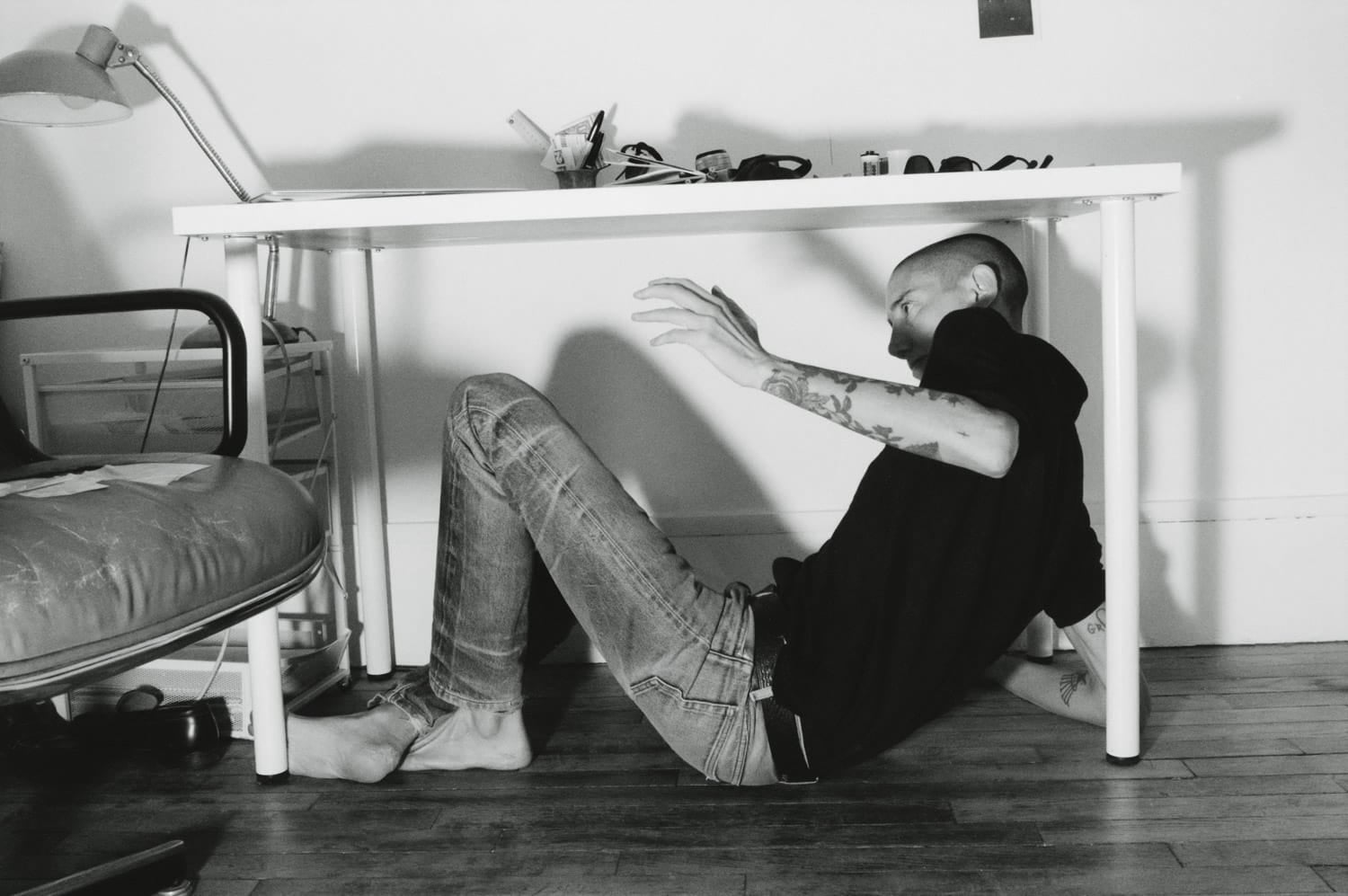
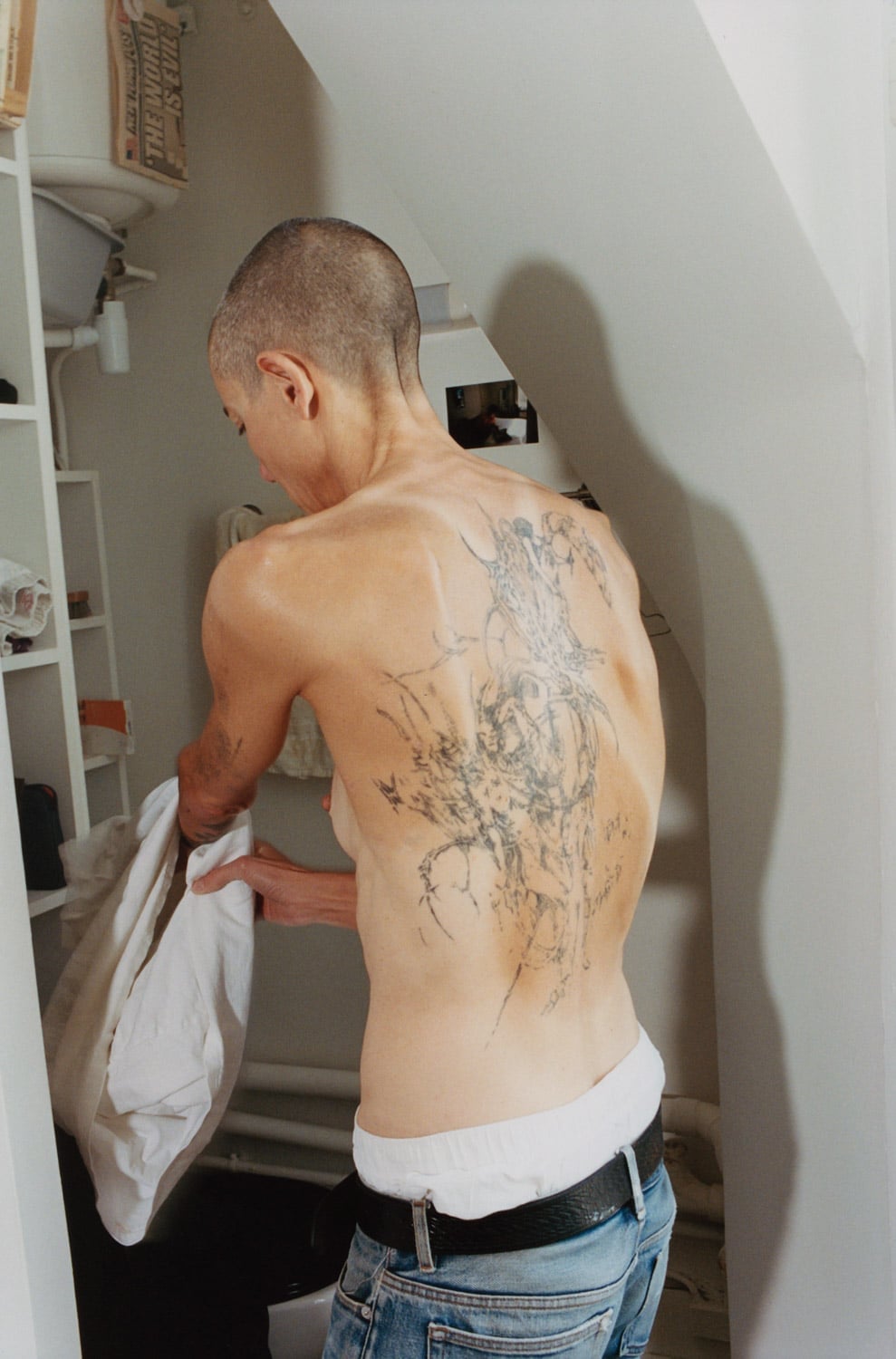
It’s mostly untrue; I haven’t changed much. There hasn’t been a transition—an evolution, as for everyone, yes. But I basically wear the exact same clothes as I did when I was 20—the same jeans, the exact same shoes and jackets. I’ve worn my flight jacket for more than 30 years. I’ve almost always had short hair—not shaved, that’s true, but short. The ‘new’ things were the tattoos, but it’s so common nowadays that I don’t even see them as related to my ‘transition’. I have photos of myself at 20 or 30, and I’m basically the same. I’ve removed the neck tattoo now, the ‘plutôt crever’. I only had it for one year, I think.
Why?
I was tired of answering the questions it provoked. It’s not my life motto, it’s not that important. It was just something I did, and now it’s gone.
‘The problem is that even with girls it’s all become banal. It’s just sex, just love. Nothing new’.
What struck me here is the word ‘just’.
The best part about something new is not the actual thing, but that it’s new. A new relationship is not exciting because it’s a relationship, but because it’s new. Also, I think love and sex are loaded words. They can mean so many different things. Sex or love, like everything else, can be exhilarating, boring, embarrassing—it’s not this constant trance and happiness. I mean, how many times—talking about sex—was I lying in bed with someone thinking, ‘What am I doing, what is she doing, what is this’. Sex is not always great, and love is the same; you are not constantly in love with the person you love. Sometimes you are indifferent, sometimes you are annoyed, sometimes you hate her or him or them, sometimes you don’t care—and 10 minutes later you are, again, totally into that person. That’s why it’s so confusing.
‘I might never have become a lesbian if I hadn’t been his mother first, I might never have dared, I might never have understood’.
How come?
I love that you saw this line. It’s probably the most sincere sentence I have ever written. I think that becoming a mother—having this little boy and loving him—taught me that I couldn’t lie. You can’t lie to a young child, to your child. There is this moment when they begin to talk, when they understand what you are saying, and discover language. So what do you talk about? You talk about the world. This was the most philosophical experience of my life. Suddenly I was asked, by someone who knows nothing about the world, what the world is about, and I realised I had to answer that. It’s very different from talking to people who are on the same knowledge level, or who at least pretend they are and pretend they know what the world is about. But here I was suddenly explaining the world to my son. And at the same time as my son was questioning everything and asking me questions—and they were so sincere—I started to ask myself, ‘But what is the world?’ I started to question everything, too. I didn’t want to lie, because if you lie about yourself, everything you tell your son is questionable. If I wanted him to trust me, I had to be as true as I could.
How old is your son now?
Eighteen, he’s just turned 18.
Do you know if he’s read Love Me Tender or Playboy?
We actually just talked about it again recently. When I wrote Love Me Tender, I was seeing him maybe once a year. He was only 11, but it was still important to me to warn him that this book was coming out. I wanted him to know that it could feel violent, that people could talk about him, that because they’d read about me, it meant that they’d also read about him. Although I changed his name in the book, people could still recognise us. I told him that I trusted him to be able to read it, but I also recommended that he not read it—not because I didn’t want him to, but I know it can feel embarrassing to read your parent’s book, especially this kind of book. I told him what I was writing about, but, still, it’s different when you read it for yourself. So, when we talked about it again a month ago, I asked him if he had read the books now, and he said no. He keeps following my recommendation. He said that, once, he’d tried. He’d been in a bookshop with some friends who picked up my book and said, ‘Hey, isn’t this your mum’, so he opened it and read a few lines, but then put it back on the shelf. The other day he was playing with the idea of going to see the movie.
With Vicky Krieps. Have you seen it?
No, and I won’t. I just sold the rights. I’m not interested in somebody else’s work that’s been made out of my work. In that position you can’t experience anything else but pain, no matter what the movie actually is. So I prefer not to.

‘I’m your mother and that’s something that will never change’.
I read Love Me Tender as a love declaration to your son, but also to life itself. To me, there is a whole book in this one phrase that couldn’t be more true.
Another thing I truly believe: say what you want to say and follow what you want to do. If you follow your desire, and your desire suits the people around you, fine. But sometimes your desire is not aligned with the people around you; that’s when you have to make a choice. And sometimes that choice means you will follow your desire no matter what.
‘My secret is being selfish. For my own good and for the good of everyone else’.
Please explain.
If I do follow my desire—if I do as I desire and I’m with you in this moment—I’ve chosen to be with you in this moment. It means, I desire you; it means, I really want to be with you. I would never blame anyone for living their desire. I never blamed my son for not wanting to see me. I didn’t understand it, but I accepted it. I don’t have to understand people. I respect people in their sovereignty. I respect their desire. Anyone saying they’ve sacrificed themselves for you, it’s the beginning of manipulation. Not respecting another person’s wish means wanting to control them. Being selfish is the best moral attitude we can have in life.

‘You have to keep your body strong. To get through the fear. Fear of desire, fear of love, all the fears’.
Katharine Hepburn once said in an interview, ‘I think the whole human race is petrified. The goal is to beat the fear. Ideally you were lucky not to experience fear before the age of 15, I was lucky’. Were you lucky, too?
I was terrified as a child. But I’m not terrified of being terrified. I want to go where I’m terrified and I want to find the strength to be stronger than my fears.
‘There’s a certain joy that comes from doing things you didn’t think yourself capable of’.
Last time you felt that joy?
Ha, that’s a good one. I should put myself at risk more.
‘I no longer have mercy’.
Not with others, not with yourself. Why?
It’s the only way to respect others and to respect yourself. To me, having no mercy is like being selfish; it’s a good thing, it makes you stronger.
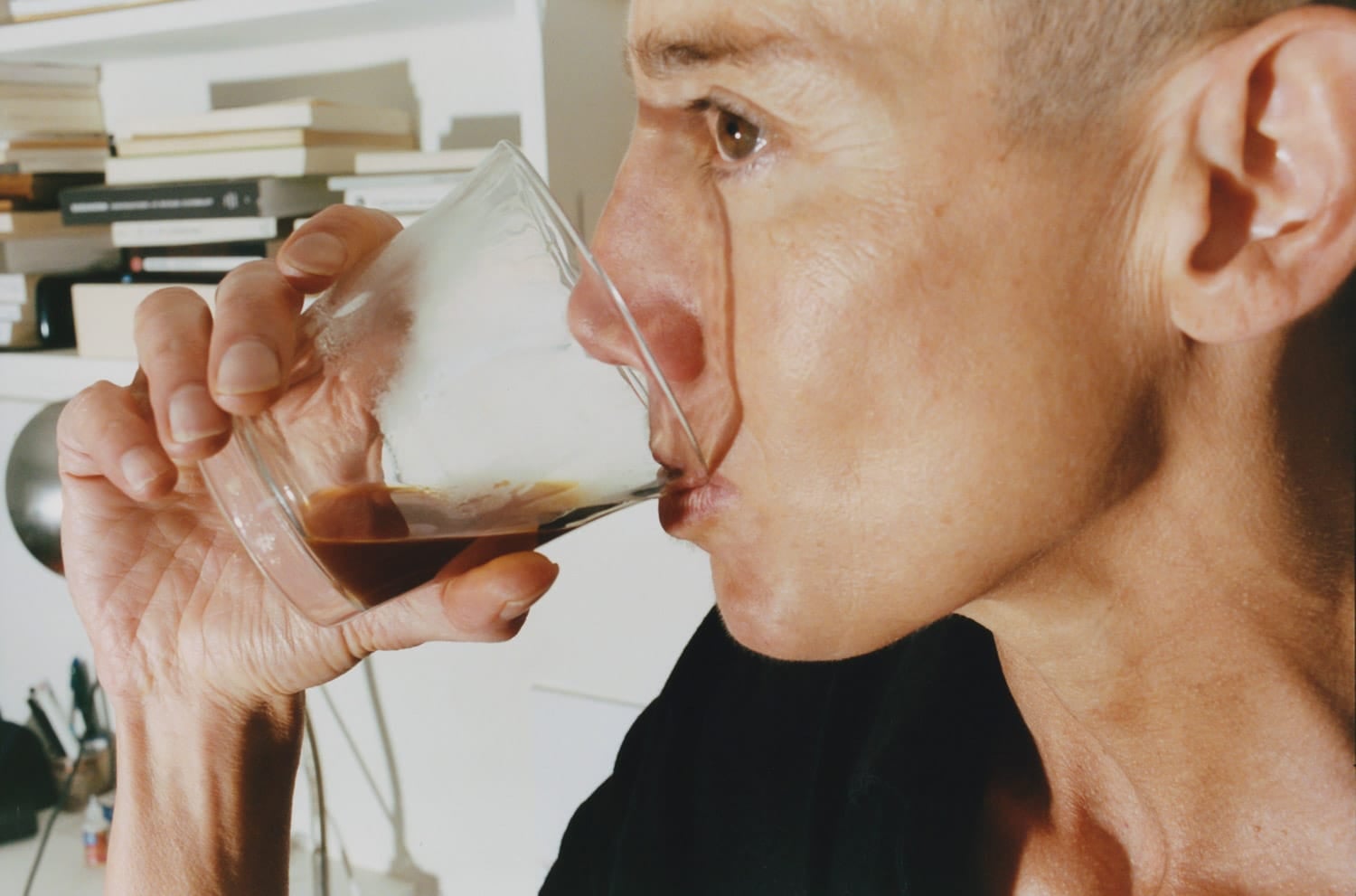
‘I never really understood why people think having junkie parents is such a bad thing. … [My sister] thinks they were completely insane. I think it’s normal lives that don’t make sense’.
Your mother died of a stroke related to her drug use when you were 16 years old; that is a violent experience. In Playboy you write about ‘the melancholy of violence, of anger, love in all its baseness’. The philosopher Slavoj Žižek believes that love is a violent act. He says that you lead your life, everything is normal, ‘and then you passionately fall in love. Everything is ruined. The entire balance of your life is lost’. He compares it with war. What is love to you?
Many things. The sweet description of love is a part of love, and we need sweet, stable, calm love—it’s great. But I am more interested in the other parts, especially those nowadays often described as the opposite of love—toxic love. This expression is everywhere now; to me, it’s exactly what used to be described as passion, something you don’t really control, that can be painful, and at the same time feels so good that you prefer it to anything else.
‘I don’t see why the love between a mother and son should be any different from other kinds of love. Why we shouldn’t be allowed to stop loving each other. Why we shouldn’t be allowed to break up. I don’t see why we shouldn’t stop giving a shit, once and for all, about love, or so-called love. … I don’t see why we absolutely have to love each other … and why we have to go on about it the whole time, to ourselves, to each other. I wonder whose idea it was … I wonder what the economic interests are, the political motives’.
Do you feel manipulated by love?
Sometimes. But that’s the thrill of it. It’s about the balance between order and chaos. I’m a total control freak, but sometimes I need someone to come into my house and burn it down and prevent me from going swimming. That is what life is about. What else is the use of love, if not being manipulated? In a way that’s the only thing I ask of love: manipulate me. I am against my own consent.
Related stories

Interview with Camille Henrot
Frederik Bille Brahe
Chapter 1: New York City

Lu Yang
 close

01/13

02/13

03/13

04/13

05/13

06/13

07/13

08/13

09/13

10/13

11/13

12/13

13/13