Soisy and the Sphinx: the homes of Niki de Saint Phalle

Soisy-sur-École/Pescia Fiorentina: It’s difficult to decide where to begin when telling the story of the French–American artist Niki de Saint Phalle. Her life and work read like a fairy tale of her own making, starting with her artistic awakening while convalescing from a breakdown. Her impulsive drive to create carried her throughout her life, manifesting in monumental habitable sculptures, gardens, fine prints, mail art, jewellery, perfume, figurative sculpture, and books—all done with a spirited intention impossible to miss. She belonged to aristocracy but rejected its trappings in favour of adventure. In 1961 she became the sole woman invited to participate in Nouveau Réalisme, an art collective that included figures such as Yves Klein and Mimmo Rotella. The art critic Pierre Restany wrote the manifesto, declaring that ‘New Realism’ was a forum for ‘new ways of perceiving the real’. For Saint Phalle this meant reimagining the way paintings could be made and how their authorship could be shared with others—concepts that kicked off what later would become circulating ideas among contemporary artists. She produced Shooting Pictures as part of her Tirs series, canvases with dripping, running colour made by aiming a rifle at strategically placed pockets of embedded paint and then firing. The theatrics of the event, often done in front of an audience with Saint Phalle wearing a white suit, stand as early examples of performance art. Shooting Painting American Embassy, from 1961, was Saint Phalle’s contribution to a summer evening at the American Embassy in Paris, where the avant-garde composer David Tudor was being honoured. Saint Phalle had begun the Shooting series a few months prior and for this event she hired a sharpshooter to fire at the booby-trapped canvas. Occasionally she would invite friends like Robert Rauschenberg and Jasper Johns to take aim. Exclusionary practices didn’t interest her; she was far more fascinated by shared experiences with a level of risk and suspense. In 1964 the Swiss–Romanian artist and fellow Nouveau Réaliste Daniel Spoerri asked Saint Phalle to contribute to the Edition MAT, a series of artist multiples—a term he coined. With a set of instructions and a ready-to-go canvas, Saint Phalle offered art-making to anyone who was up for it.
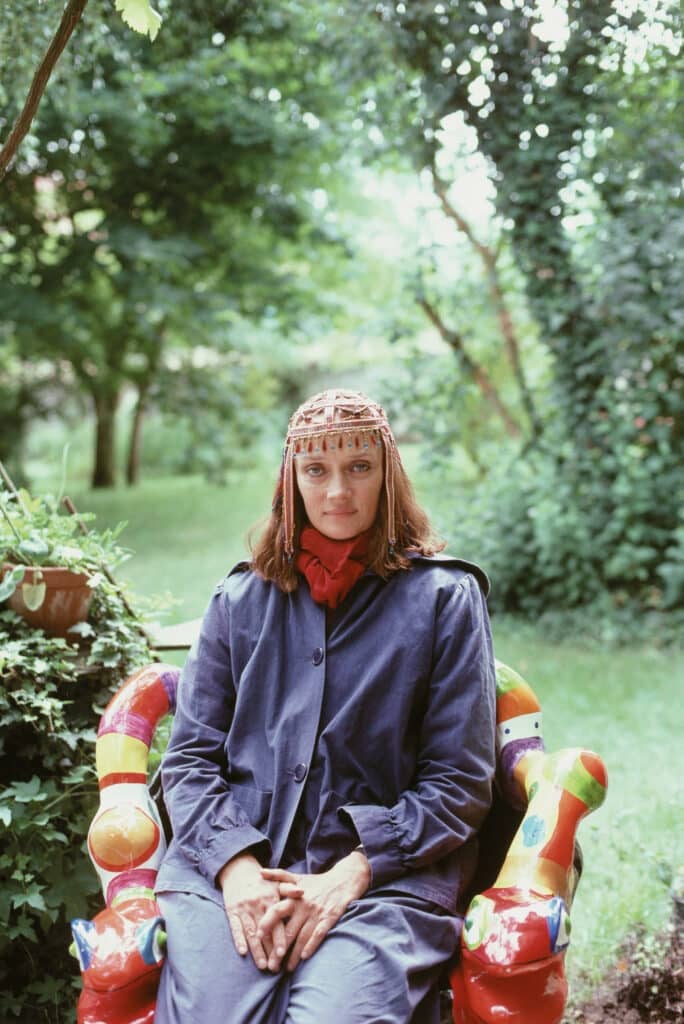
Niki sitting in one of her chairs at home in Soisy-sur-École, 1981. © Michiko Matsumoto.
1. Lean picture against a wall.
2. Put a strong board behind it (if required, in order to protect the wall).
3. Take a .22 long rifle and load with short ammunition.
4. Shoot the colour pouches, which are embedded in the plaster until they have ‘bled’ (or until you like the picture).
5. Attention! Leave the picture in the same position until well dried. Then still be careful, as remains of colour not yet dry might run over the picture.
Not to be overlooked, the Tirs also serve to exorcise trauma, something Saint Phalle experienced at the hands of an incestuous father and an indifferent mother. The violence of the ravaged paintings never waiver in their insistence to draw attention, but the trailing colourful paint reminds us that beauty can prevail when provoked.
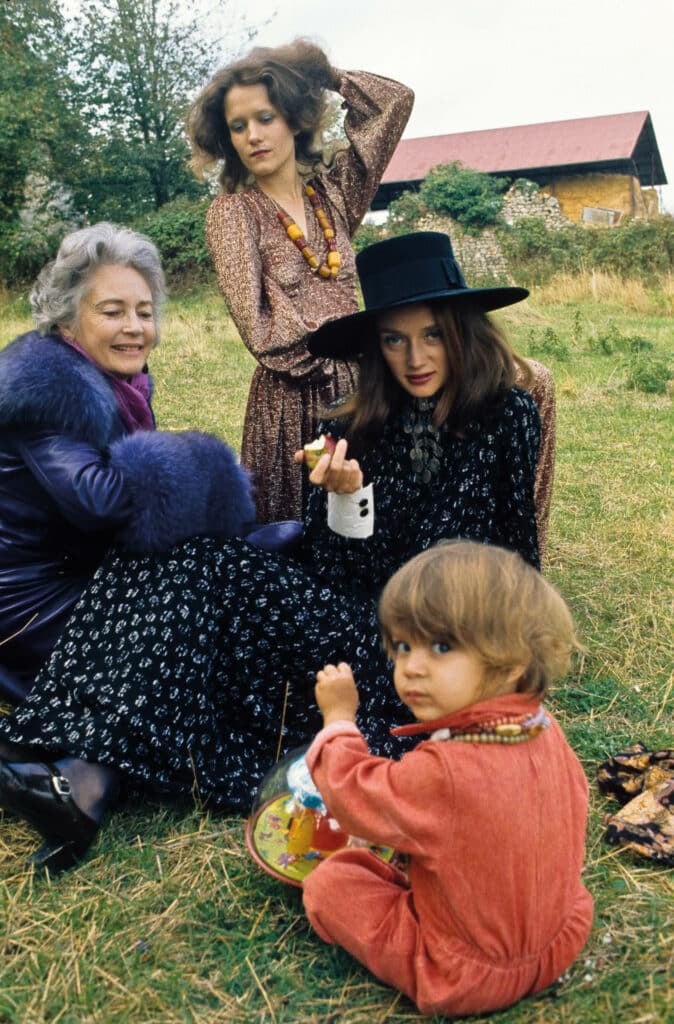
Niki with her mother Jacqueline, daughter Laura, and granddaughter Bloum, 1973. © Laurent Condominas.
Saint Phalle was born in 1930 in the affluent Parisian suburb of Neuilly-sur-Seine. The devastating effects of the stock market crash forced her French banker father, Count André-Marie Fal de Saint Phalle, to relocate the family to America where they eventually settled on the Upper East Side of New York City. Saint Phalle stayed behind with her paternal grandparents for three years before joining the others. Her mother, an elegant American from a prosperous family, who once posed in an elaborate Persian costume for the photographer Edward Steichen, was a big influence on Saint Phalle’s personal style. As a young woman Saint Phalle worked as a model, appearing on the covers of Life and French Vogue.
In 1949, at the age of 18, Saint Phalle eloped with the New York writer and musician Harry Mathews, who she had first met as a young girl. They had two children, Laura and Philip, and lived a peripatetic life in Europe before settling in France. An urge to give herself completely to her art meant she couldn’t live a conventional life, and in 1960 the couple separated with Mathews becoming the prime caretaker of the children. A personal relationship with the kinetic sculptor Jean Tinguely was formed not long after, and although it didn’t last, they remained committed to each other, working together until Tinguely’s death in 1991. Saint Phalle ensured Tinguely’s legacy by donating 53 sculptures and over 90 drawings to his namesake Swiss museum in Basel.
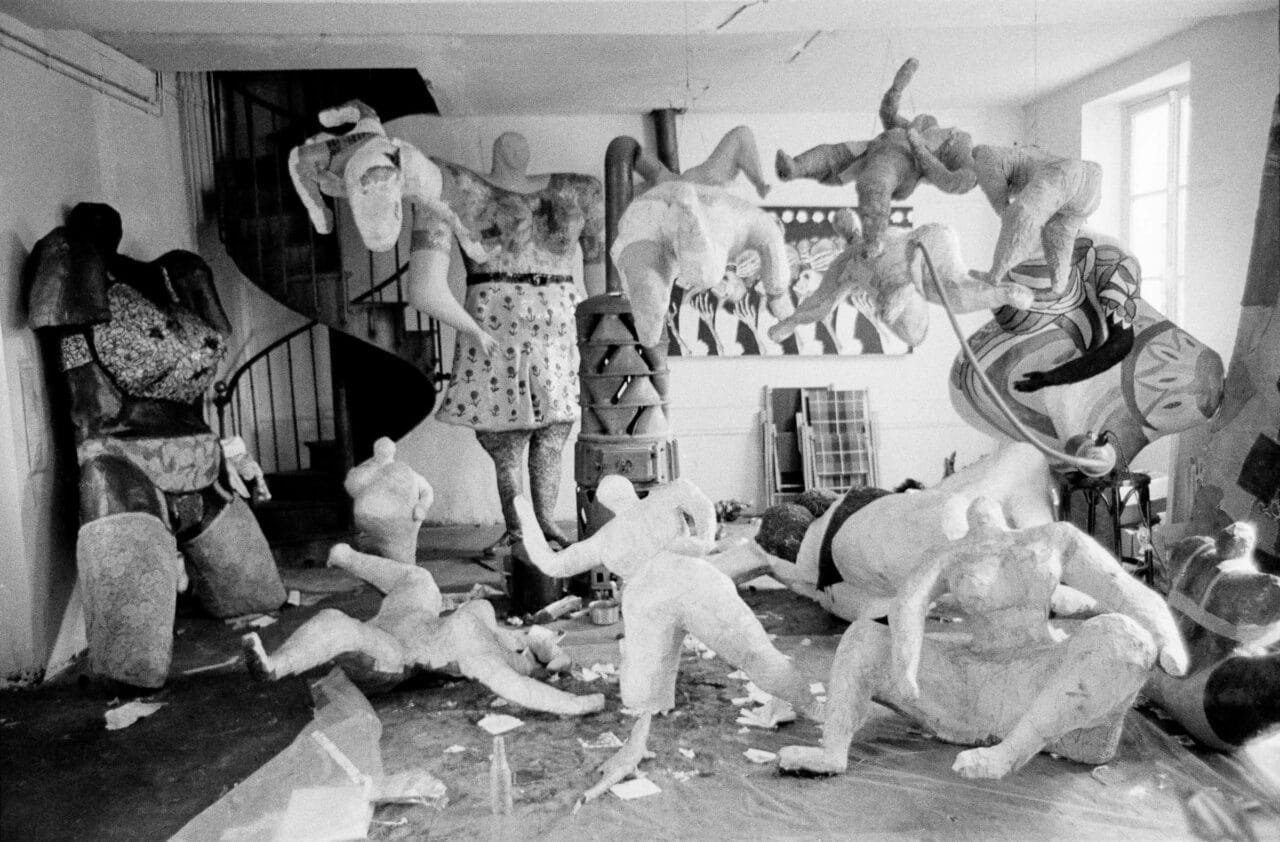
Farandole of Nanas at Niki’s studio in Essonne, France, 1965. Left to right: Lady Sings the Blues, La Waldaff, and Gwendolyn. © Delpire.
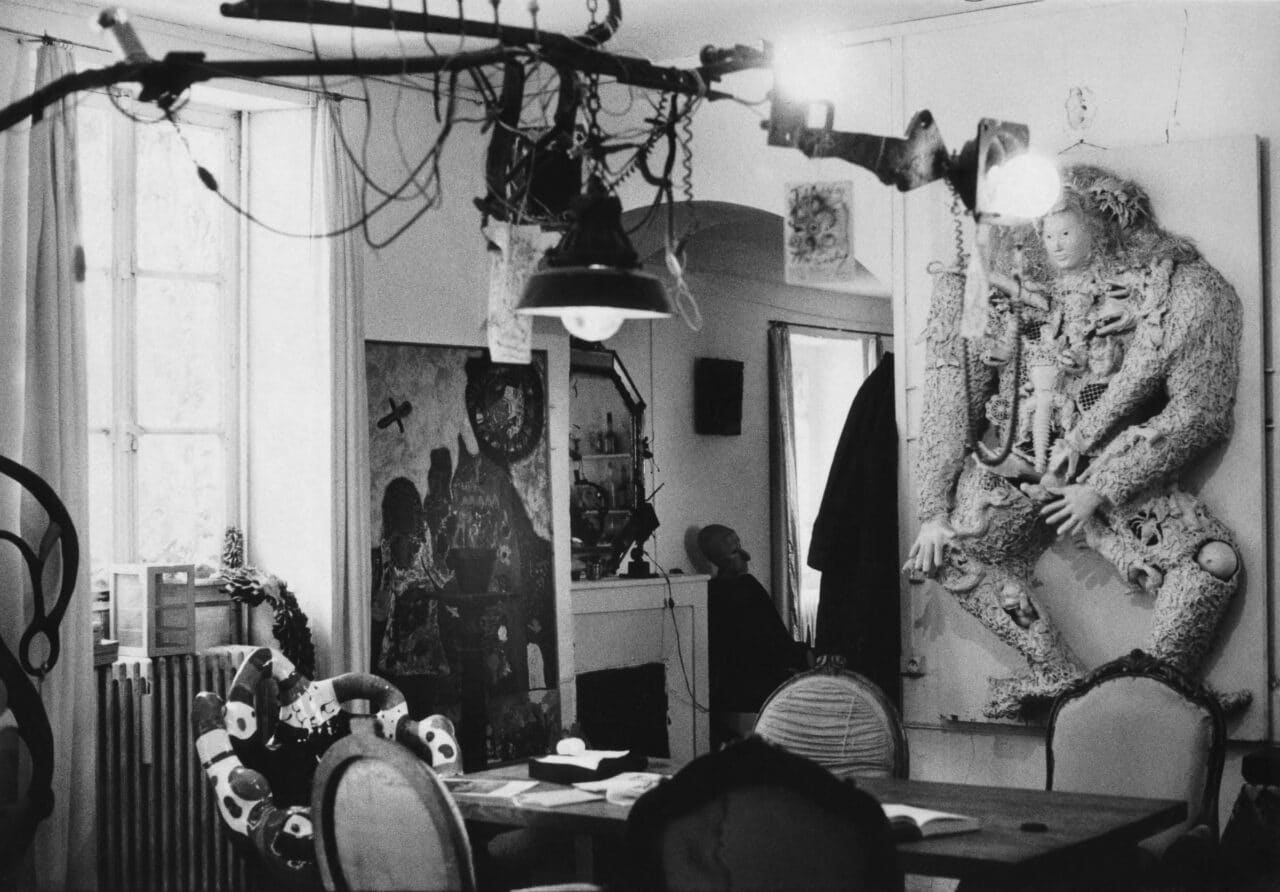
Niki’s house in Essonne, France, 1986.
While living with Tinguely in Paris, in a studio building on Impasse Ronsin, a legendary Montparnasse street where generations of artists lived—Constantin Brancusi lived and worked there for four decades—Saint Phalle conceived of her Nana series. The inspiration for the zaftig female figures affectionately known by this slang term, came from her pregnant neighbour and friend Clarice Rivers who, with her husband, the artist Larry Rivers, also maintained a home and studio on the block.
A turning point in Saint Phalle’s career came with a collaborative project between Tinguely, artist Per Olof Ultvedt, and museum director Pontus Hultén, who in 1966 was working as the director of the Moderna Museet in Stockholm. On his invitation Saint Phalle conceived of Hon—en katedral [She—A Cathedral], a giant pregnant figure resting on its back, big enough to house a fully equipped bar, cinema, and art gallery with an entrance through the figure’s door-sized vagina. Numerous monumental projects eventually followed, culminating in the Tarot Garden, a sprawling hillside collection of structures and sculptures that Saint Phalle worked on for 20 years. Bloum Cardenas, who I spoke to for this story, remembers going to see her grandmother while the garden was under construction.
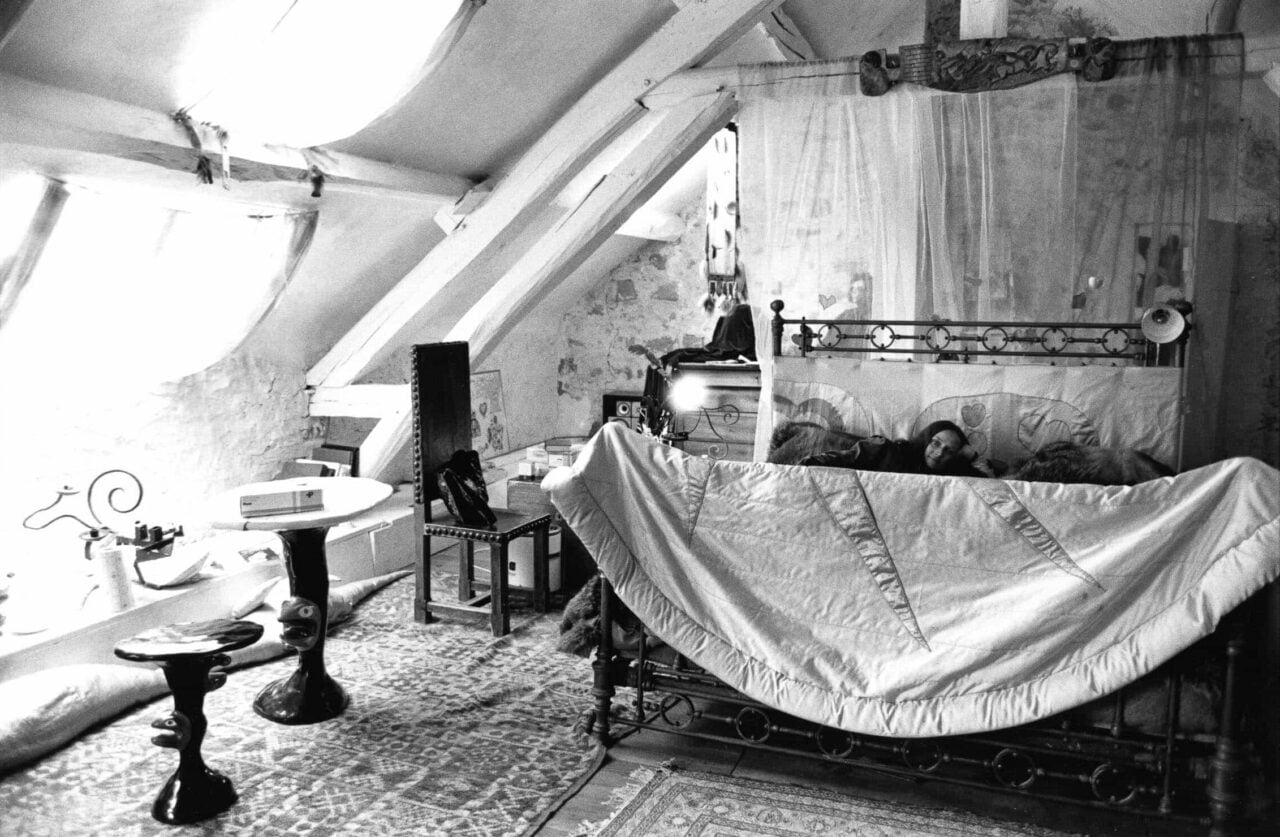
Niki in her bedroom in Soisy-sur-École, 1981. © Michiko Matsumoto.
When did you start going to the Tarot Garden?
I first came when I was around 10 years old.
What do you remember?
Jean and Niki always talked about their projects, and I had already seen some of them built, but the Tarot Garden was all hers and on a scale that was over the top. The first time I came The Sphinx was still being welded. The second time they were pouring concrete on the floor. I saw all the different stages come together, from rods to concrete. She was starting to build a team and they were all working for her; she was the master of it all. I used to visit at Christmas and on school holidays. It was a normal environment and yet it wasn’t so normal. Kids didn’t believe me when I told them about the Cyclops sculpture that she and Jean had built in Milly-la-Forêt. By then I wasn’t talking about the Tarot Garden to others, just to my oldest friend because she knew my grandmother.
You were intimately aware of the imaginative and playful ways she constructed habitable sculpture.
My first experience of a big Niki sculpture was the Dragon in Knokke. I was little, maybe two or three years old. That was a place where Jean and Niki would take me as they were building it. Some people are doctors; my grandmother built houses that looked like monsters.
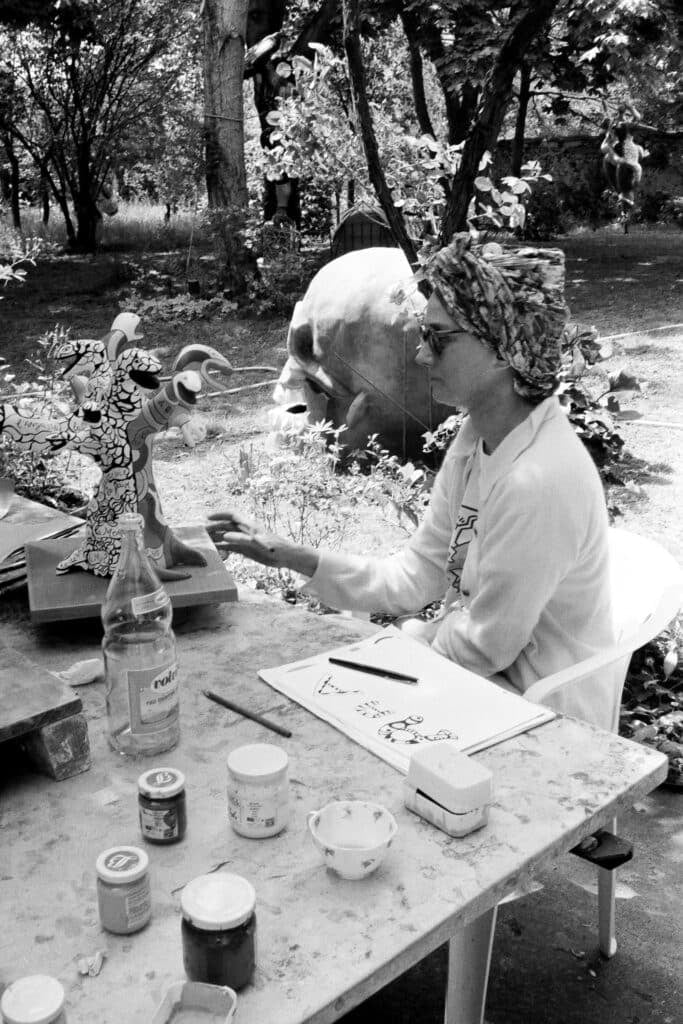
Niki working outside the studio at the Tarot Garden, Tuscany, 1989. © Laurent Condominas.
It was agreed that after her death nothing further would be done to the sculptures at the Tarot Garden, but there was some concession for The Fool.
She always talked about not liking its placement in the garden. In tarot, the Fool has no number, it’s a free character, and she identified with that card. At first I thought we should keep changing the location of the sculpture, keep it wandering as she did, but it was too much of a responsibility. Niki moved it twice before and we did one last move. We placed it in nature, looking out to the world. My dream is to have Rachel Pollack return to do another tarot reading of the garden so we can be sure it’s the right placement, but I do feel it fits with her narrative. It’s at the end of the road in the garden and it seems like a natural place.
In the ‘50s Niki paid a visit to the 19th-century hand-built stone castle called the Palais Idéal du Facteur Cheval, which was conceived, apparently in a dream, by Joseph Ferdinand Cheval, a postman. In 1962 she staged a shooting painting in New York called Hommage au Facteur Cheval and one of her longest-running assistants at the garden was a postman named Ugo Celletti. What a poetic coincidence!
There’s never any coincidence with Niki. She was passionate about the Facteur Cheval. She discovered it with my grandfather, Harry Mathews. It was also a provocation with Jean Tinguely because they were, as he said, megalomaniac artists, and she said to him at one point, ‘You think you’re all that, but I know greater artists than you’. And he was like, ‘OK, who?’ Then she took him to see it with a whole lot of other people, including the artist Larry Rivers and his wife Clarice. It had a huge impact on her and Tinguely too.
The situation with Ugo is a beautiful story. While she was working on the Tarot Garden the locals thought she was crazy because they couldn’t understand what she was doing. The postman, as he was delivering the mail above the hill, saw the garden regularly and started coming by. He eventually started working there and did so until his death. He found a different meaning in his life, as many others did, but he was the one who helped the local community understand the value of what was going on. No one was getting it, but he understood.
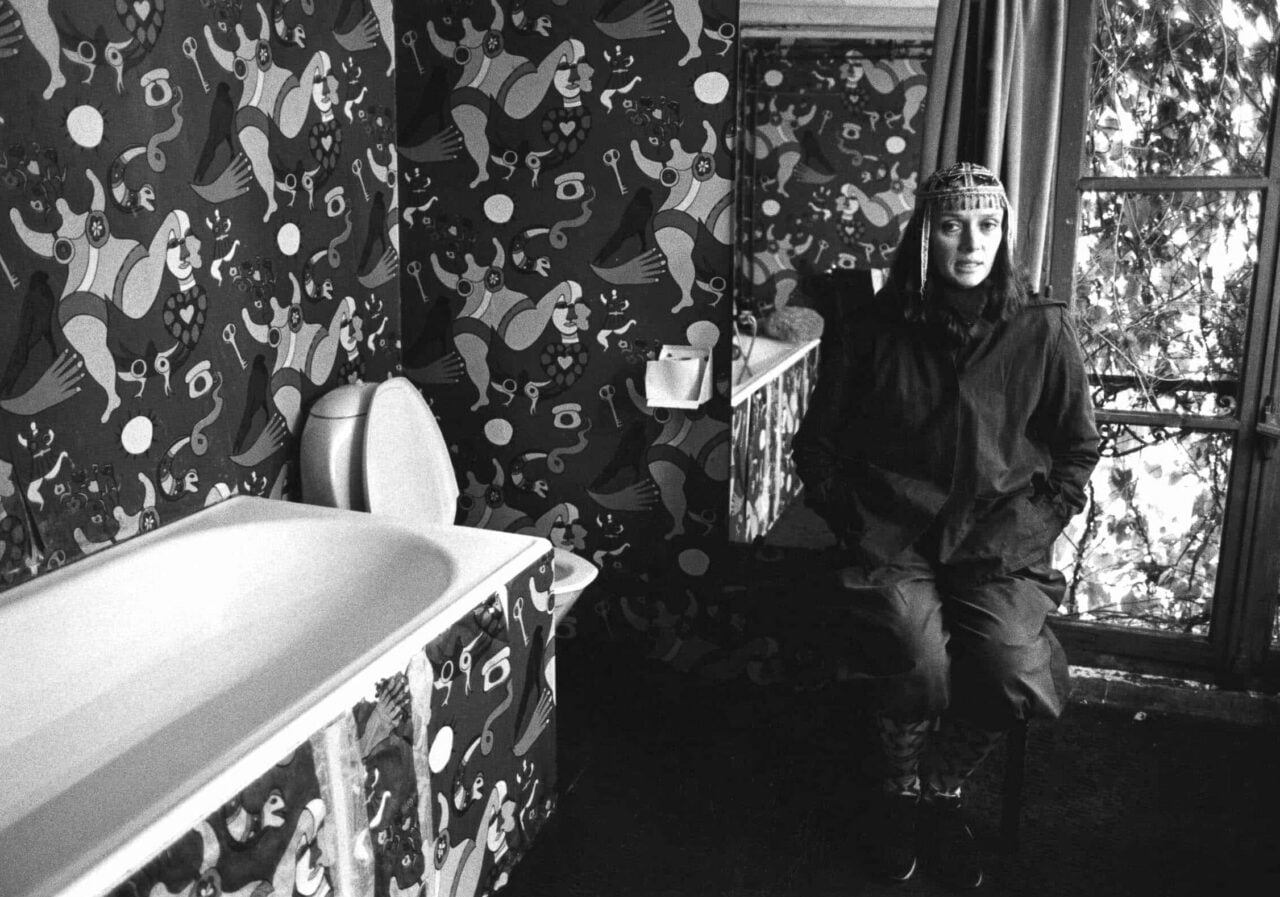
Niki in her bathroom in Soisy-sur-École, 1981. © Michiko Matsumoto.
It’s such a beautiful story. A postman is a wanderer too, like Niki’s association with the Fool.
Jean and Niki really appreciated the mail and they did a lot of mail art. Jean would send all kinds of crazy things, like toys or parts of boxes with little metal rods. Every morning she spent hours writing letters, and when Jean was there they would sit facing each other and do it together. She was disciplined until the end of her life; every morning was dedicated to answering letters.
Niki had strong ties to her family of assistants and collaborators.
She created these families because her own family relationships were very complicated. She felt guilty for having left her children to do her art. She felt this way until the end, and it became a story that she couldn’t free herself from, but through her work she could create family and intimacy. In a sense I was lucky because I was the grandchild she had at 40 years old. She turned her guilt of motherhood into becoming the greatest grandmother of all time, and she was.
That’s great.
Where I’m even luckier is that I have a double family as well. There are generations of people who continue to work at the Tarot Garden and at the Foundation. She created these bonds that were much easier than her own family.
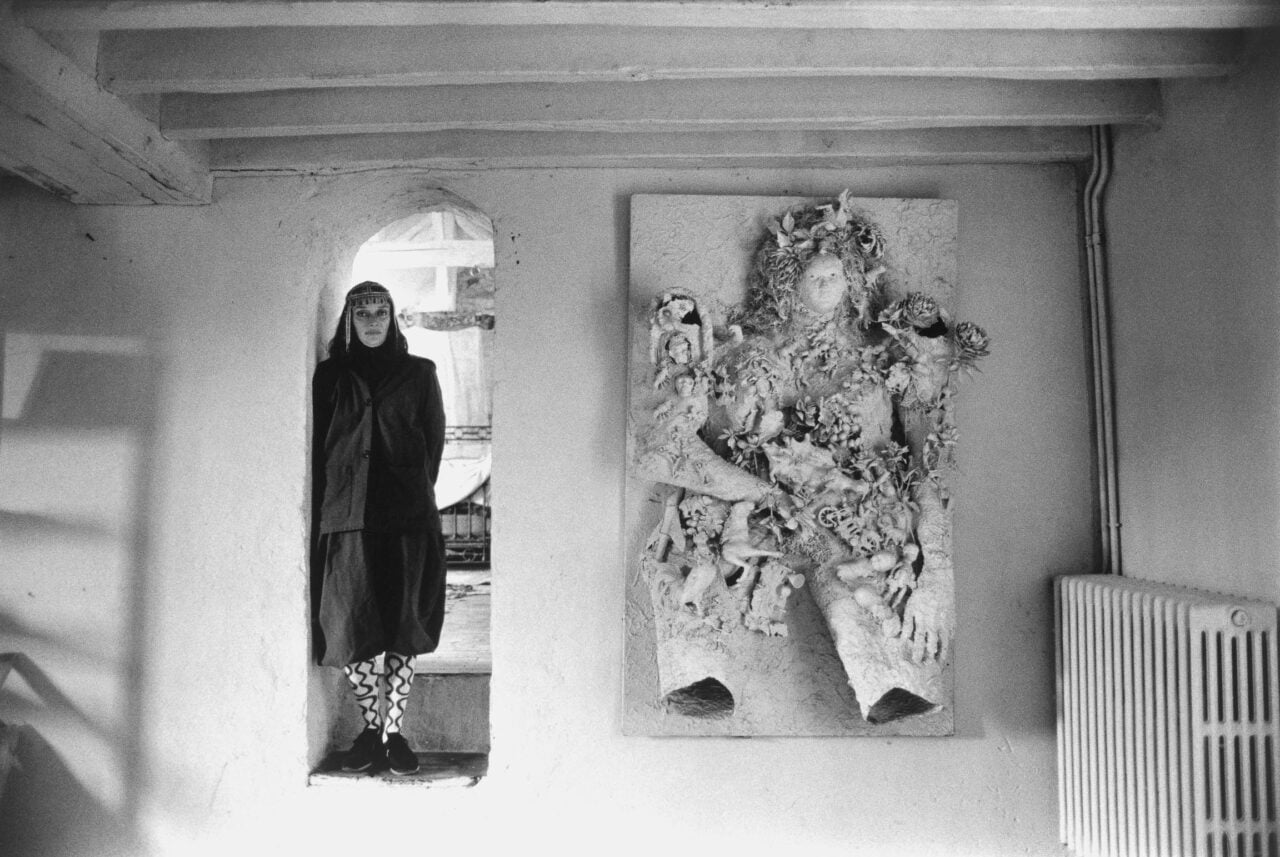
Niki with her early work at the entrance to her bedroom in Soisy-sur-École, 1981. © Michiko Matsumoto.
Niki lived in The Sphinx. Can you describe what the domestic setting was like?
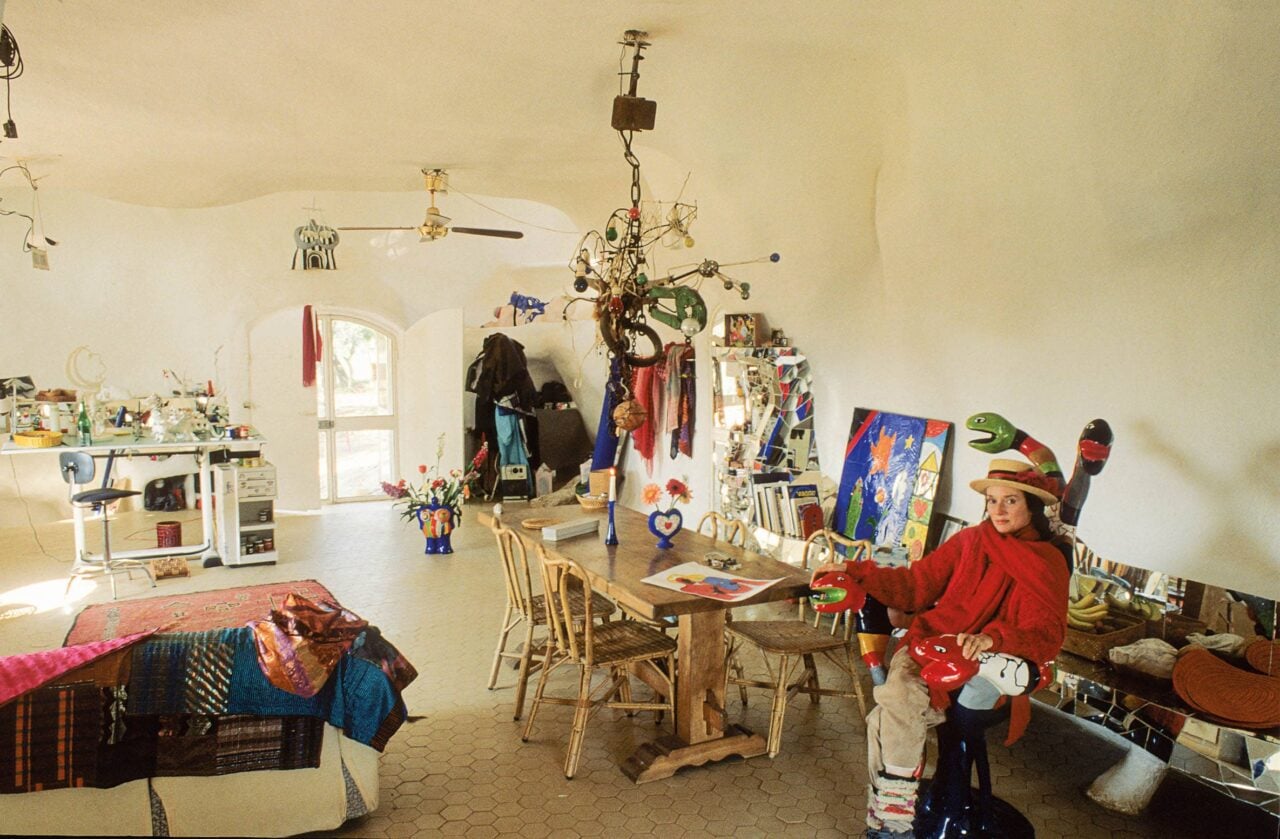
When I came to visit on my own we’d sleep together in her bed. At the time there weren’t mirrors all over; they were in certain areas like on the chimney, around the windows, and in the kitchen. Jean made a big lamp that hangs over the dining table, like he’d done in her other house. That made it homey. I loved taking a shower in her snake shower, that was really fun. It was also the first time I ever experienced heated floors. As she was building she knew it was going to get cold and humid, so she put heaters below and then realised years later that it was really bad for her arthritis. But it was a real pleasure to walk around barefoot with heat coming from the ceramics.
Did she like to cook?
No, she liked to eat. One of her greatest pleasures was food. Niki took Italian lessons when she lived in The Sphinx so she could communicate better with her team. It felt like a normal home, but it was always used as a workspace as well. She had a small living room around the chimney where she had a stereo system and two couches. It’s where she would do her laughing therapy. Then there was the mosaic table where she would work and have dinner. There was also a ping-pong table that doubled as a worktable. She was proactive about her health and was always trying to find ways to heal, so she played ping-pong to strengthen her wrists. Once she began to work on the Tarot Garden, all kinds of health problems started to get worse.
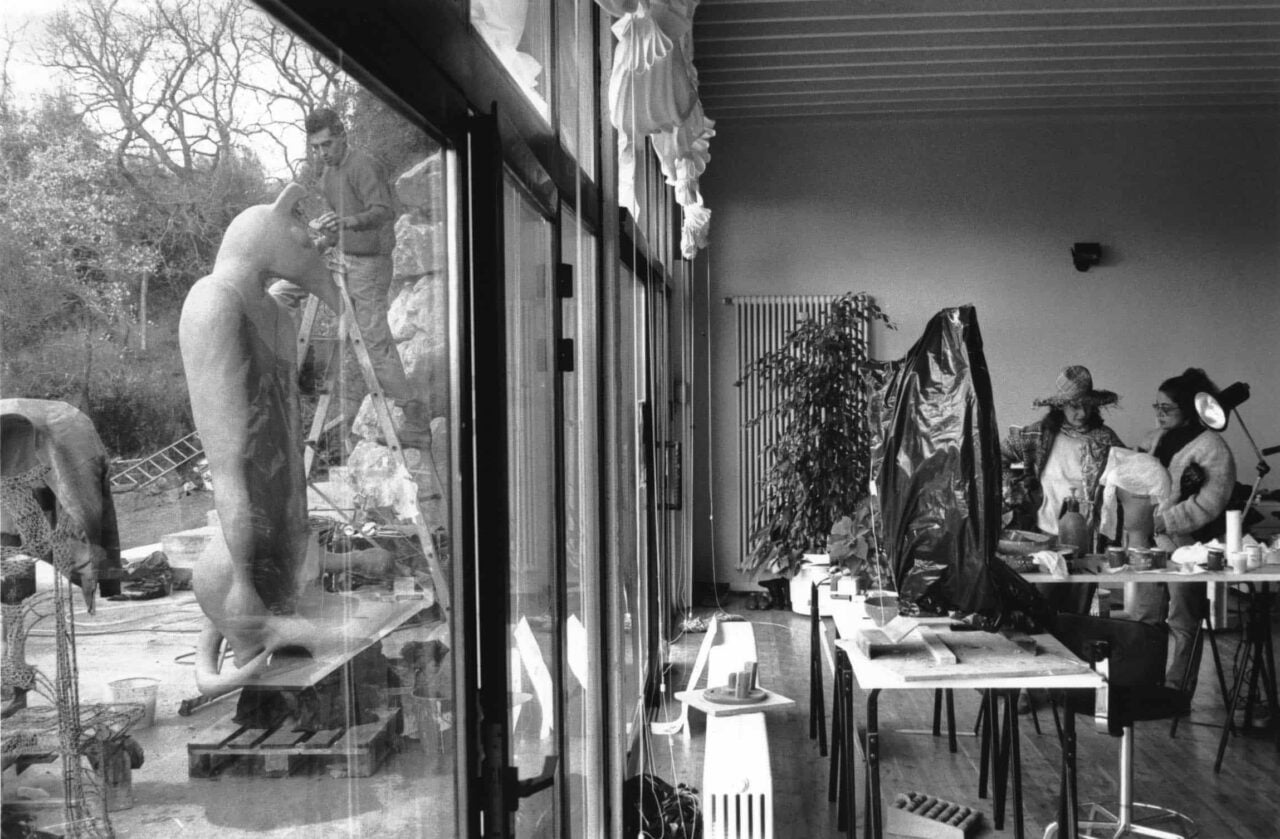
Niki and her ceramist Venera Finocchiaro.
In 1988 after living in The Sphinx for six years, she had a New York–style loft built underground. What led to that decision?
She felt living in The Sphinx was like a return to her mother’s womb. As the relationship with her mother wasn’t so good, it became suffocating. After fighting angles her whole life, she realised she had accomplished this desire of living in curves and not being attacked by angles. It was time for a change. She dreamt about a New York loft in Tuscany, and she built it.
Where is it on the property?
It’s under The Moon. People walk over it and have no idea it’s there.
Amazing! How is that space used today?
We turned it into a workspace. It was a bit brutal for the team when I told them to get rid of the bed and all the furnishings. We turned her bedroom into the office and cut the loft in two: one area is a working space used when the weather’s bad, the second area is where we store all the ceramic moulds of the garden. The same ping-pong table is there.
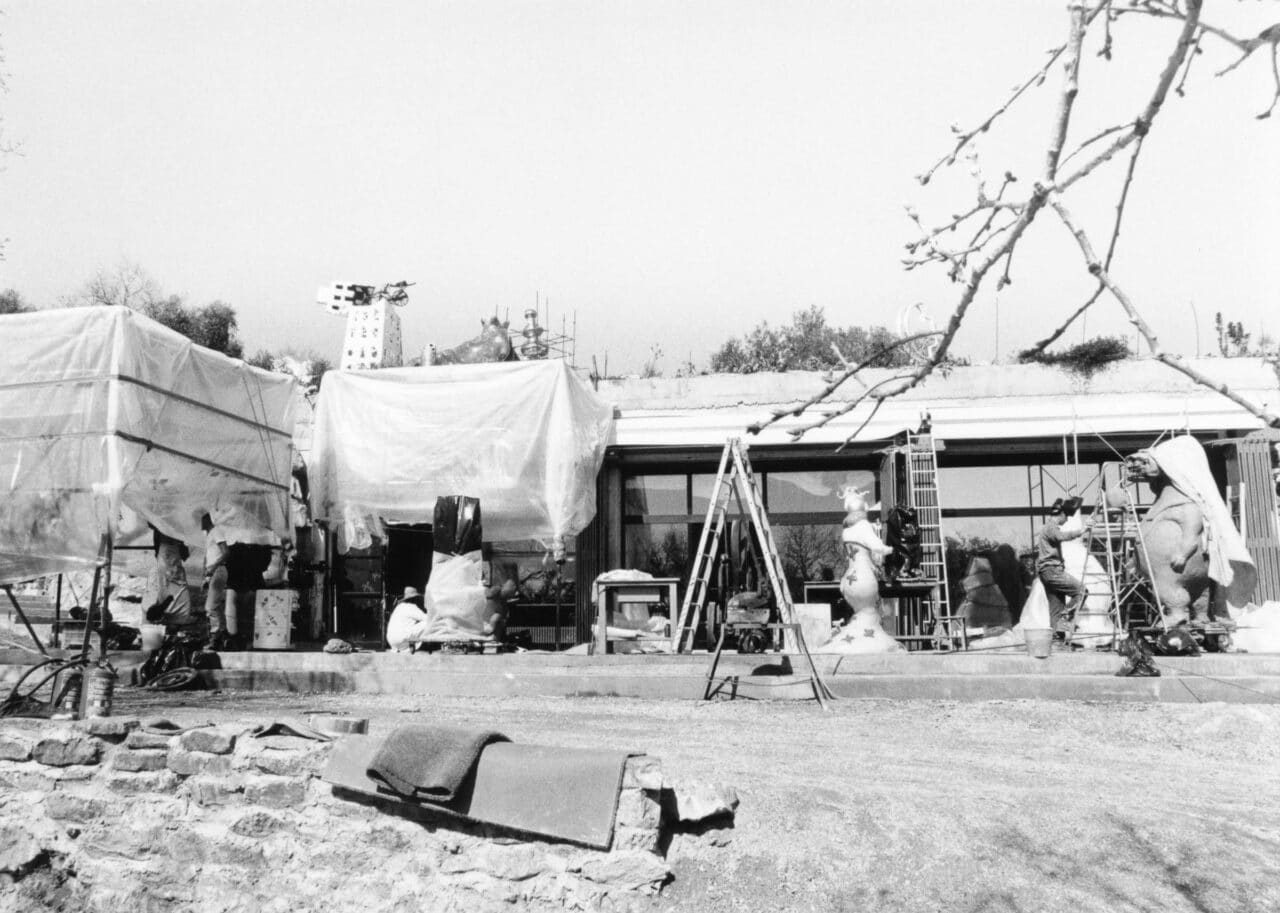
View from outside Niki’s studio at the Tarot Garden, Tuscany, 1990. © Laurent Condominas.
In her childhood home in New York her mother was obsessed with mirrors and had them all over the walls in the hallways and in the living room. Is that where Niki developed an interest in mirrors?
The mirrors appeared in the Tarot Garden because she didn’t like the shape of the hand above The Magician. She thought the fingers were too little and too fat and she wasn’t satisfied with the visual results. She found a solution in mirrors, which made the shape disappear because they reflected the sky and the trees. After that discovery, mirrors started taking over her life. Her use of mirrors came as a solution to a problem, but that’s not to say she didn’t later realise this connection to her mother and to the Snow White fairy tale: ‘Mirror, mirror on the wall, who’s the fairest of them all’. Niki loved myth and stories. She was also a beautiful woman who was honest about her vanity.
In 1963 Niki moved with Jean Tinguely to Soisy-sur-École, to the Auberge du Cheval Blanc. It became a home base from which they would travel to and fro. What is the history of the house?
It was an inn and a brothel. Before the Second World War, there was a lot of social life in the villages outside of Paris. Jean Cocteau and Jean Marais lived in Milly-la-Forêt. Jean and Niki went to Soisy because it was close to where Marcel Duchamp lived. I also think they were influenced by the American gallerist Virginia Dwan, who was connected to the land art movement, which saw artists leaving the city, leaving the system, and doing their own adventures. They just wanted to work, work, work, and they couldn’t do that in Paris because there were too many distractions. We’ve had a few people give us testimony about the house. The plumber, who had been going there since he was a child and whose father was once the plumber, told them stories about when it was a brothel. In a small area upstairs there used to be 17 bedrooms along a hallway with 17 little beds to just do your thing. Downstairs there’s still a bar with the zinc. Niki’s studio was behind the bar in an opening where they used to do projections. Outside there was a space for dancing.
Niki sat on one of her sculpture chairs inside The Empress at the Tarot Garden, before it was covered with fragmented mirrors. © Laurent Condominas.
How do you remember the place when Niki and Jean lived there?
At first they were living in another village next to Soisy called Dannemois, but then Niki decided to move back. At that point Soisy operated like a storage space. I remember seeing lots of Nanas all jammed together in the room that became her bedroom. They stored stuff there for a few years. They also had two studios, one for Jean and the other for her. Jean was a welder, so he took out every single window in the house to let the smoke out. Niki got pneumonia. He didn’t realise she had these health fragilities. He put back all the windows.
Did the house function as a home?
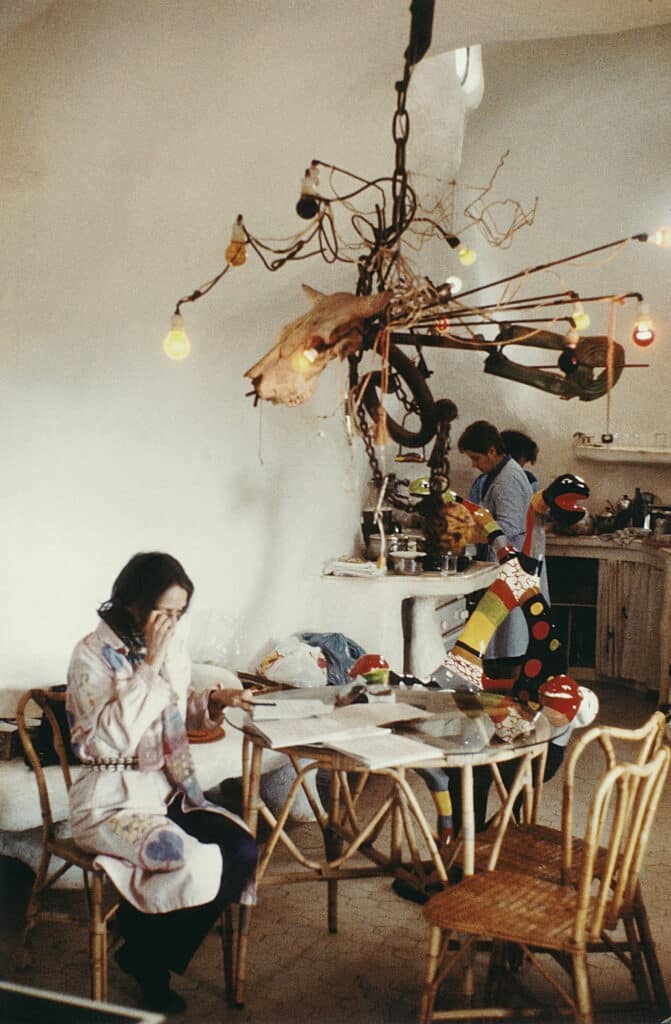
It did. I’ve often said if the table in the kitchen could talk, it would have the best stories to tell about the people who came to visit, the scenes that happened, the fights, the food. Once I was doing some deep cleaning and I thought, ‘Oh no, I’m washing away history’.
What stories come to mind?
Niki was very proud that Sophia Loren came by and made pasta. Then there was the story about giving away Brancusi’s stove, which used to be in the house. I asked her why she did it and she just said, ‘Oh, well, so-and-so wanted it’.
photographer unknown
You spend time living in the house now.
Niki gave the house to my husband and me in the ‘90s. It was really difficult for me because it meant that she would eventually die, which I wasn’t at all prepared for. I have to thank my mom because Niki first offered the house to her, but she said, ‘Oh no, don’t do that because you know I’ll just sell it’.
In what ways has the house changed and how is it the same?
Niki and Jean tore up all the little rooms upstairs and made a bathroom and another room. I haven’t changed anything really. For the first time we’ve added some tiles in one of the bathrooms in order to protect the walls. This bathroom has the original Nana wallpaper that Niki made. I have two rolls that I’ve kept over the years. I’ve cut parts to send to the archives and now I can use whatever is left to put back as it was. Rico Weber, who was an assistant to both Jean and Niki, used to come and spend time with us regularly before he passed away. He would always say, ‘Oh my god, the house has different people in it, and there are many children, but the energy is the same. Everybody’s working somewhere, doing something’. It was really sweet to hear that from him because it’s true. It’s always been this way.
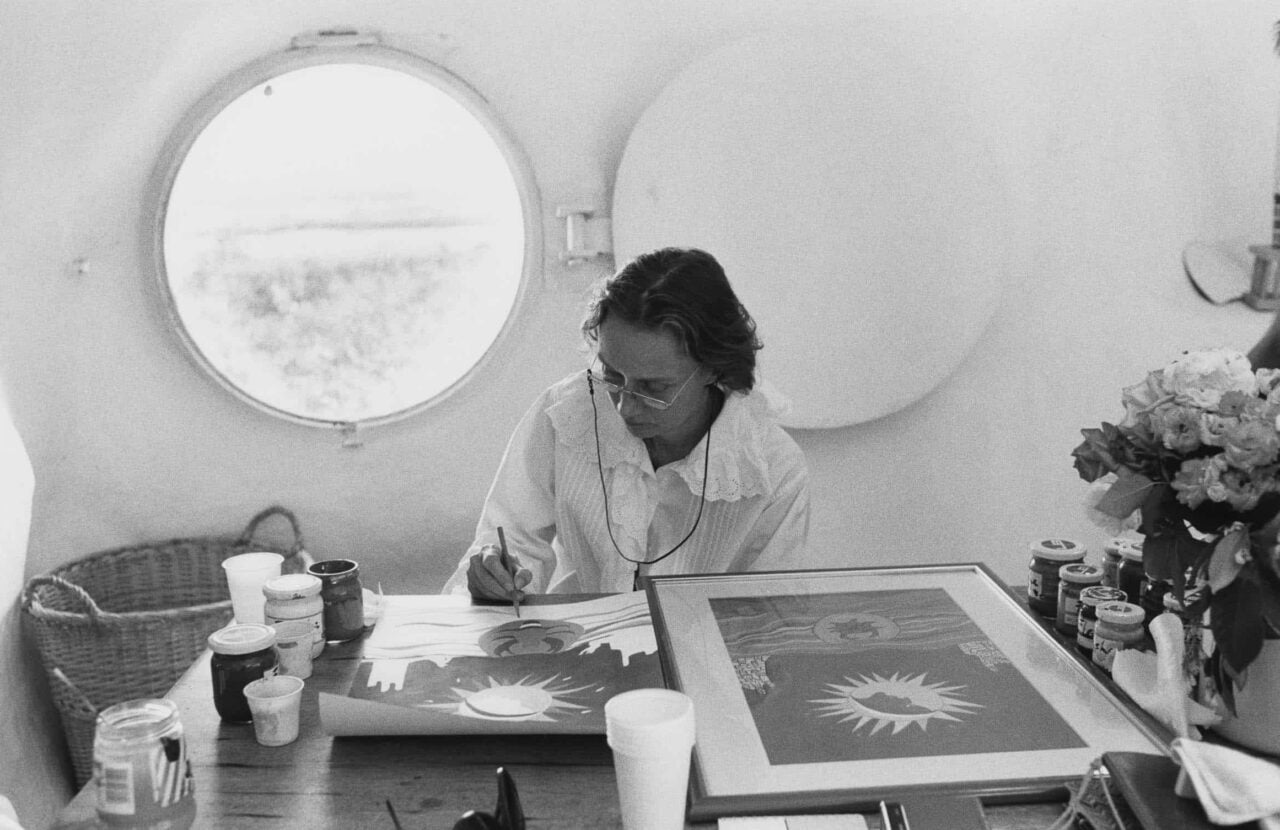
Niki working inside The Empress at the Tarot Garden, Tuscany, ca. 1985. © Michiko Matsumoto
Niki entrusted you with the house. Do you feel a responsibility to keep it as it was? Was she expecting you to?
Niki didn’t believe in mausoleums. She doesn’t have a tomb. I’m a bit stuck in my sentimentality. I’m trying to free myself, but their presence in the house is there in various ways.
Themes of impermanence and death crop up in her work. With Hon—en katedral, 1966, her first monumental habitable sculpture at the Moderna Museet in Stockholm, she planned for the destruction of the work when the show closed. She understood the precariousness of life.
Absolutely. Jean did also, his kinetic art is all about how life is movement and when it stops, well, you’re dead. Our impermanence is what is precious about us. I remember people and institutions regularly asking Niki about redoing Hon and she would say, ‘No. You had to be there’.
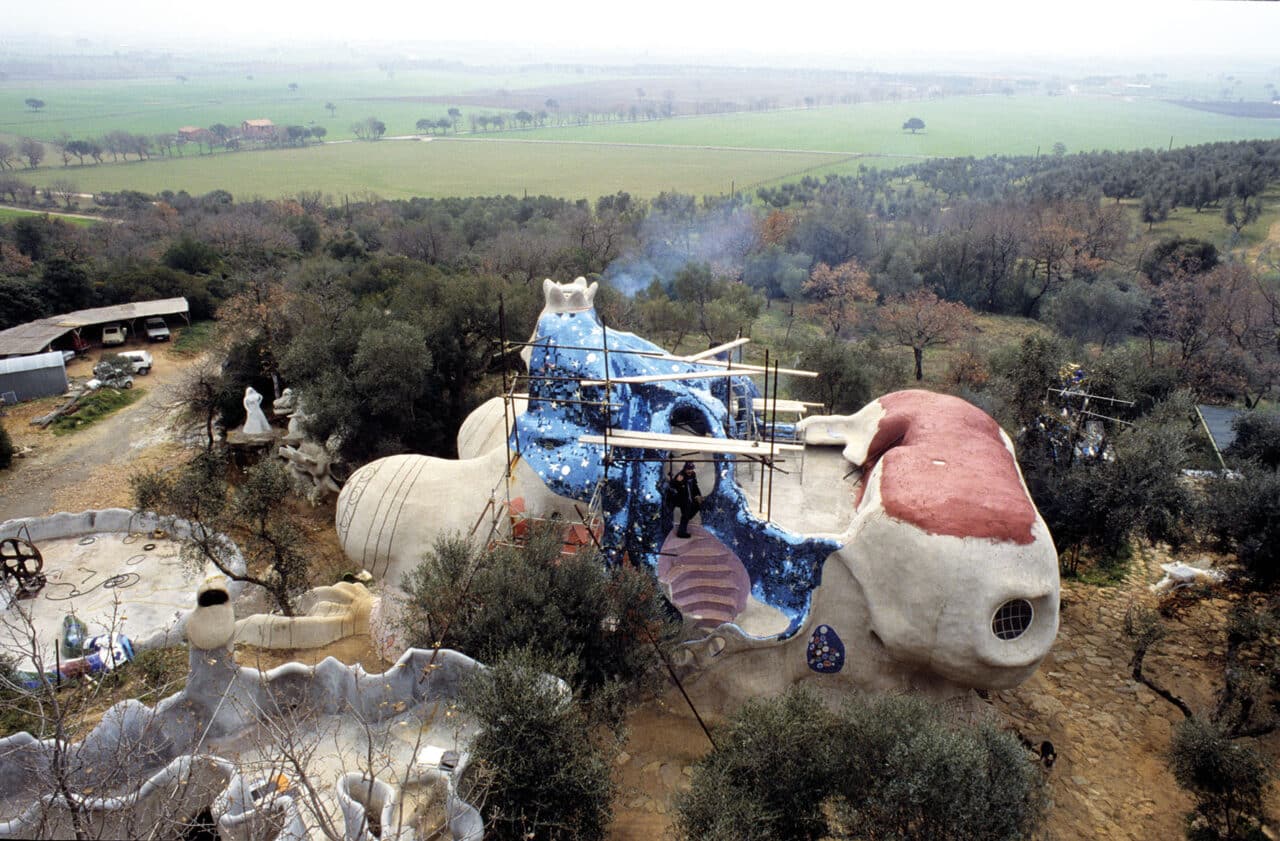
Overview of the Tarot Garden. © 2021 Fondazione Il Giardono Dei Tarocchi. Photo: © Laurent Condominas.
Niki also believed in making permanent structures. It was an opportunity to indulge her interest in architecture. Le Rêve de l’Oiseau, from 1971, was her first architectural commission. How did this project come together?
The theatre director Rainer von Hessen was a close friend and collaborator. He understood that Niki had this very free nature and if you tried to put a hold on her you were sure to lose her. He was smart enough to know to give her space, then so much was possible. Rainer was extremely generous with Niki because he knew it was more than the monumental that interested her, it was architecture. When you see her early collage work she often slipped in the words ‘mort aux architectes’, death to architects. In the ‘60s there was a lot of criticism about architects and their work, the lack of consciousness and consideration for the people using the space. Niki was really an artist who wanted to be an architect. She was interested in seeing things move away from the masculine, dark, military-like sculpture common in public art. She wanted to change the shape and rethink what society could be. Rainer let her try this out for the first time. Jean was there participating, Clarice Rivers was there with her children, this group of friends were there helping to make things happen and trying to change the world, one work of art at a time.
This was a chance for her to experiment, to learn from the mistakes and gain from the successes.
The structures of Le Rêve de l’Oiseau were so strange from the inside to the outside. There’s a lack of logic. You can see it’s the first trial because it’s still very angular. The bathroom is great! You can understand why after this project she wants The Sphinx to be completely different.
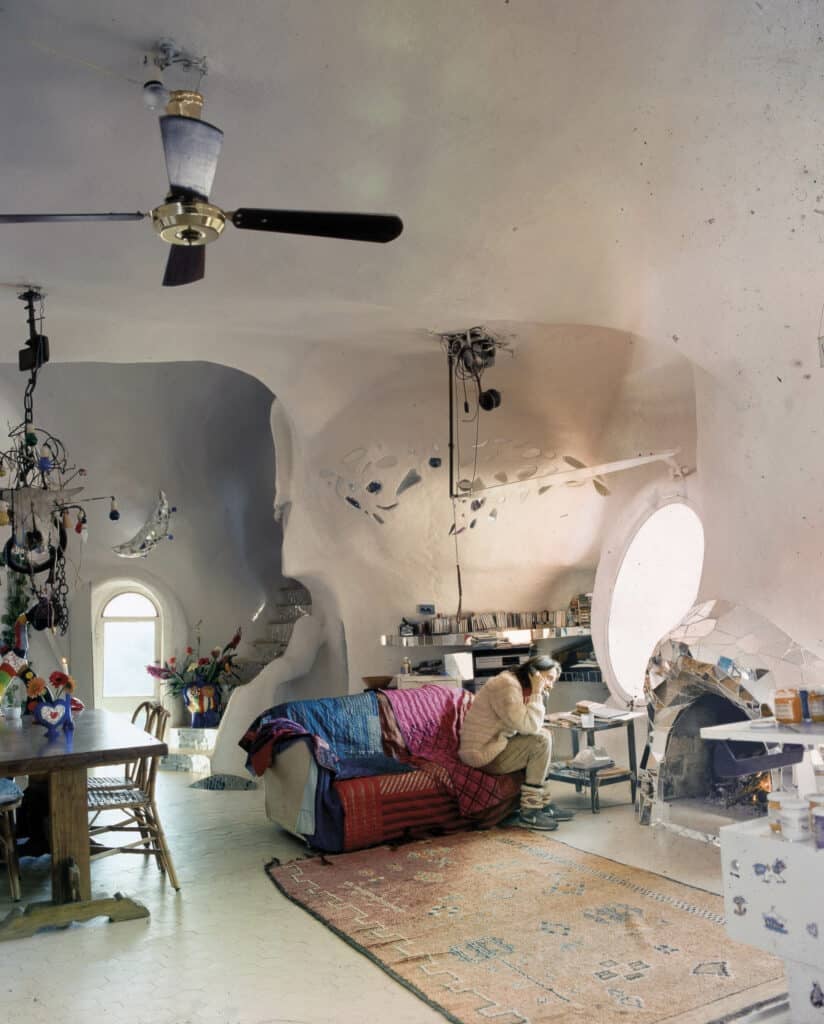
Niki on the phone inside The Empress, Tuscany, 1987. © Laurent Condominas.
Two years later, in 1973, she built a playhouse called the Dragon in Knokke-le-Zoute, Belgium, for the children of Roger and Fabienne Nellens. She put everyone to work painting it, including Roger and the Formula One racing car driver Jacky Ickx, who painted a small car on the exterior. She invited this kind of collaboration on all her projects. Keith Haring painted a mural on the interior staircase. How did they meet?
One summer, Keith just arrived at the Tarot Garden. He was a total groupie taking Polaroids of Niki and Jean. It was the first time I realised that someone knew who they were. He was so childish and happy. He had a great relationship with Jean. Roger’s brother Jacques held contemporary art exhibitions at the Knokke Casino every summer and he would invite Keith to participate and to stay in the Dragon. Keith loved staying there so much he asked Niki if he could paint something.
She liked science fiction, fantasy, mythology, and fairy tales. Did she impart these interests on you when you were young?
She used to read Edgar Allan Poe stories to me with this tone in her voice and giant eyes. She was a great reader. She thought being afraid was important because it meant you had to conquer your fears. She liked that these stories came with a lesson.
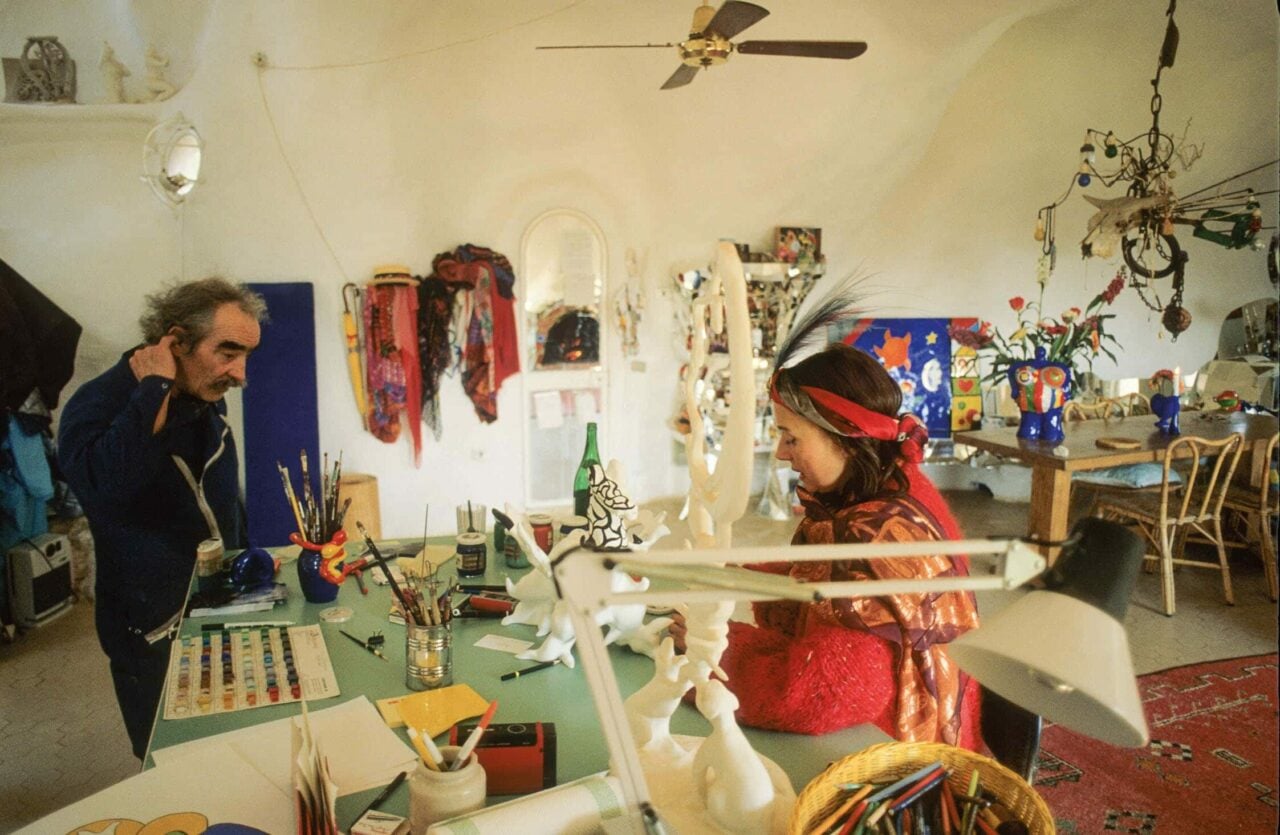
Niki painting with Jean Tinguely at the Tarot Garden, Tuscany, 1990. © Laurent Condominas.
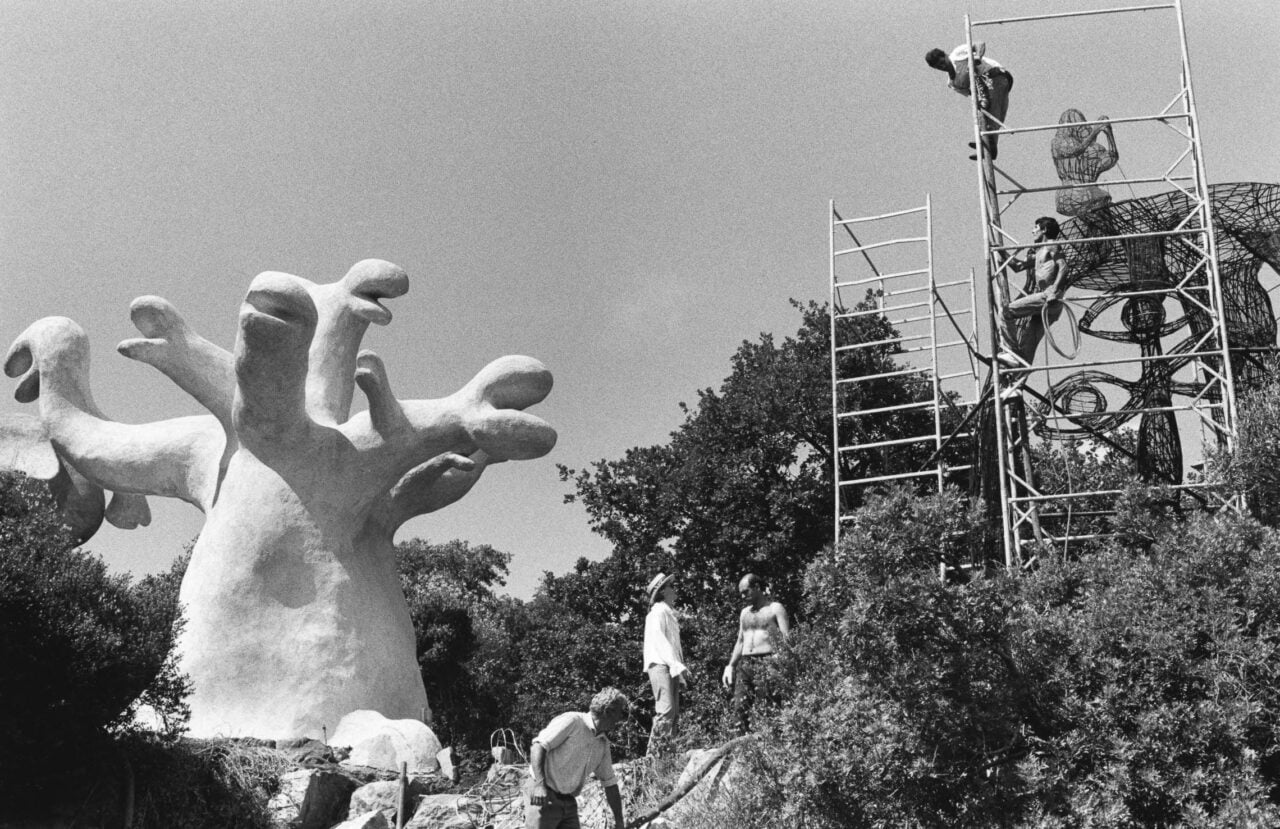
Niki at the Tarot Garden, Tuscany, 1985 . © Michiko Matsumoto.
Niki had to argue this point while defending her project to the parks commission in Jerusalem, which called her playground design too scary for children. She did prevail and The Golem was built in 1972. Its distinguishing feature includes three tongues that act as slides.
The three tongues in this sculpture represent the three major religions working together, just as the children play together on the slides. At the Tarot Garden, after the team left in the evening she would go and inspect everything. It was always when the shadows came up, and the shadows tell a different story. The garden feels different when it starts to get dark; you can feel the potential danger. Seduction is dangerous and I think Niki played with that, even with the colours, which are a form of seduction.
Her work vacillates between the horrific and the forbidden aspects of fantasy and fairy tale, and the overt joy and redemption that can triumph in these stories. For example, she made a relief called Château de Gilles de Rais, referring to the 15th-century child murderer often cited as the inspiration for Bluebeard, the savage French folk tale character. In contrast, she built the Nana Dream House, a cocoon-like safe space. She straddled these two emotional places, the light and the dark.
And Gilles de Rais was her ancestor.
No! I didn’t know that.
She once brought it up in an interview and equated herself with him. It was a rebellious move against her family.
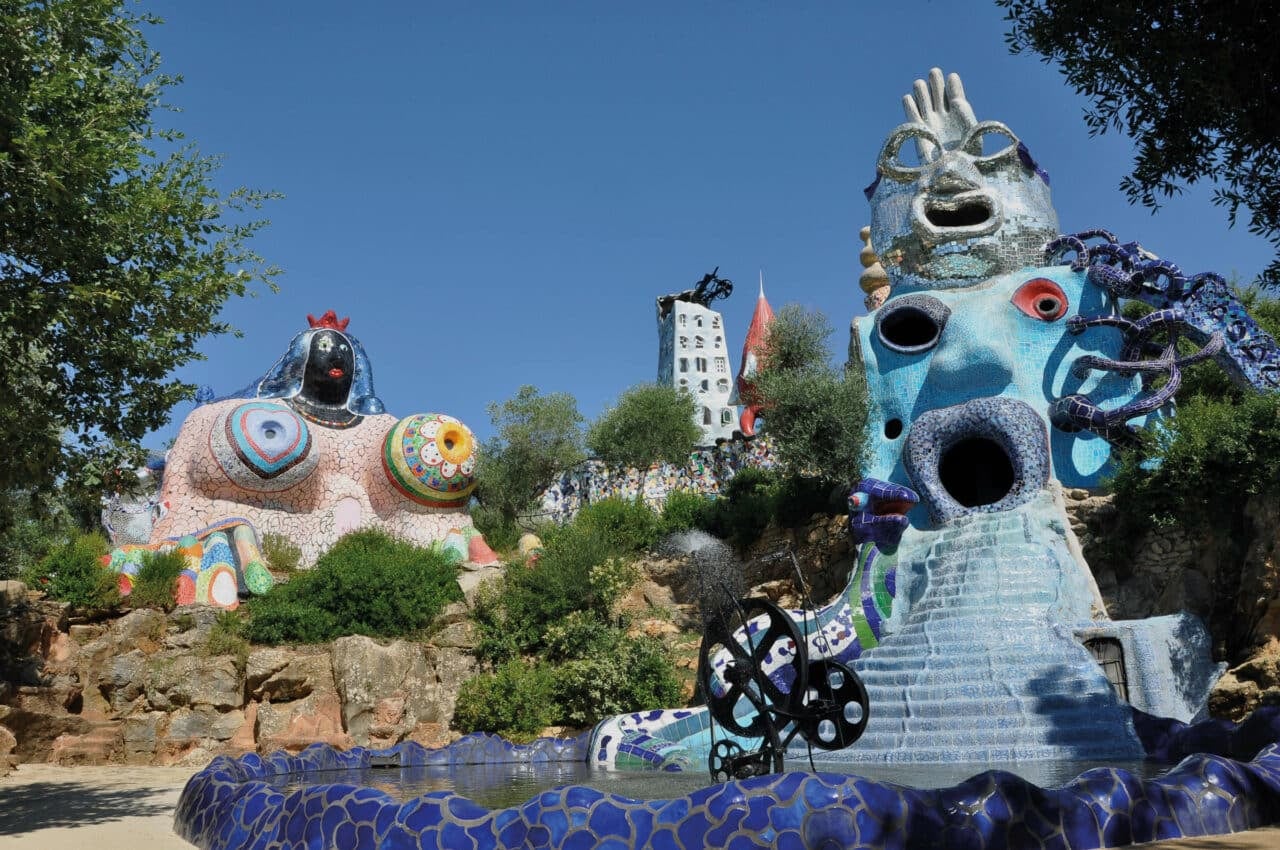
The Tarot Garden, Tuscany, 2018. © Michiko Matsumoto.
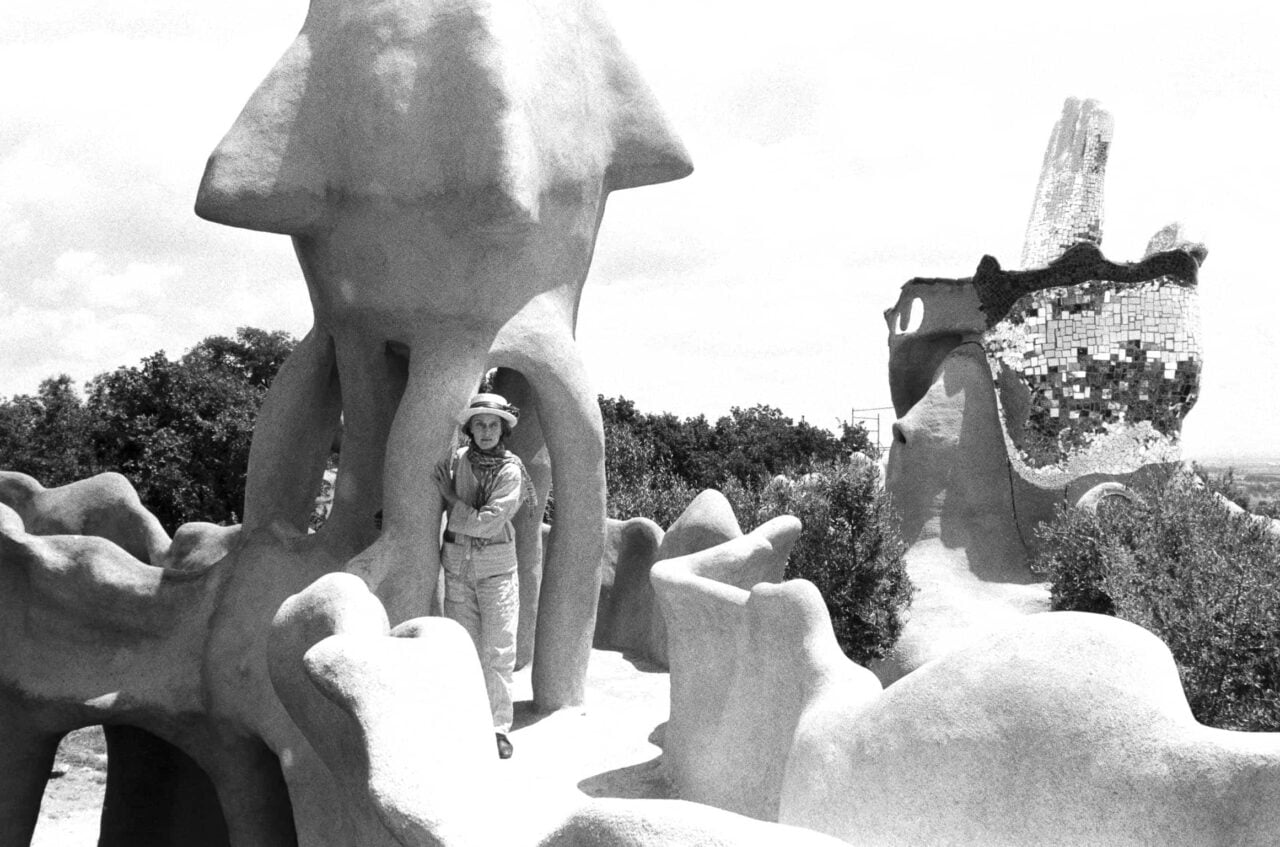
Niki with The Emperor at the Tarot Garden, Tuscany, 1985. © Michiko Matsumoto.
Queen Califia’s Magical Circle opened posthumously in Escondido, California, a year after her death in 2002. She consulted on the planning with the indigenous community, including with Blue Cloud, an Ojibwe leader from Winnipeg, Canada, which happens to be where I was born. This was her last public work. What was her inspiration for building it and what role did Blue Cloud play in her life?
When Niki returned to the US from Europe she was surprised by two things: the lack of respect for jazz and for Native American culture. Queen Califia was a mythical goddess that represented different aspects of California’s history, which includes Spanish, Mexican, and Native American cultures. She didn’t want to offend anyone, so she asked for help in placing the totems around the park. That’s how Blue Cloud came into her life, and they had an intense and special friendship. When she was sick, he came to the hospital three times to perform healing ceremonies. He also came to do a blessing when she passed away, and he was there when we opened Queen Califia.
Niki imagined a world and then built it; she was a queen in her own castle, mythic in stature.
She kept the Tarot Garden a secret. She didn’t talk about it. She felt it had to be an adventure, so either it happens to be on your path or it’s not. It’s the same with Queen Califia; it’s hidden in the park and you have to find it. It’s like the treasure chest at the end of the story; you get the goodies or you don’t, it depends on the path you take.
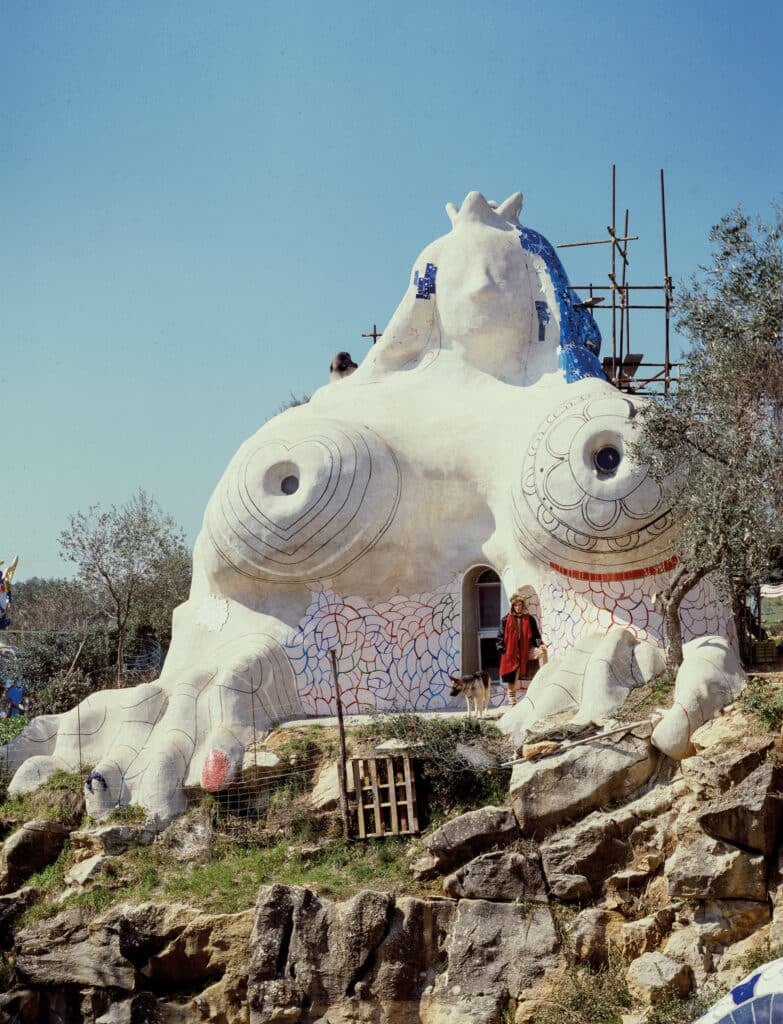
Niki outside The Empress at the Tarot Garden, Tuscany, 1987. © Laurent Condominas.