Sabine Marcelis

Rotterdam: Rotterdam is a rough industrial city. Yesterday was cloudy, and it looked grey and flat; the light made all the buildings look exactly the same. As well as the best architecture, they have some of the ugliest buildings in the world, and the fog doesn’t make it better. I thought, ‘How can anybody live here?’ There is some romanticism in this, I suppose. I had been here before as an Erasmus student, visiting some friends. The nights were long on Adderall (that we were free to buy in coffee shops) and it was fun, but we were almost assaulted twice in one night and I remember running around in the streets while being chased by gangs of kids. It’s probably not like that anymore.
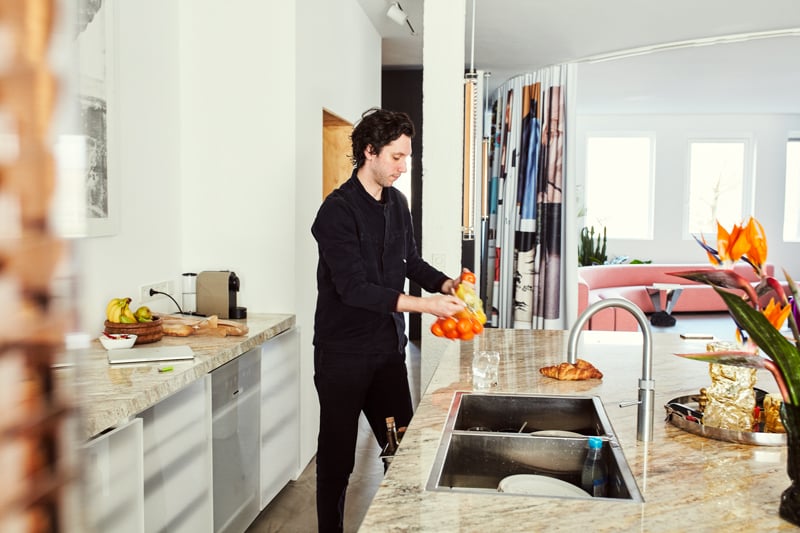
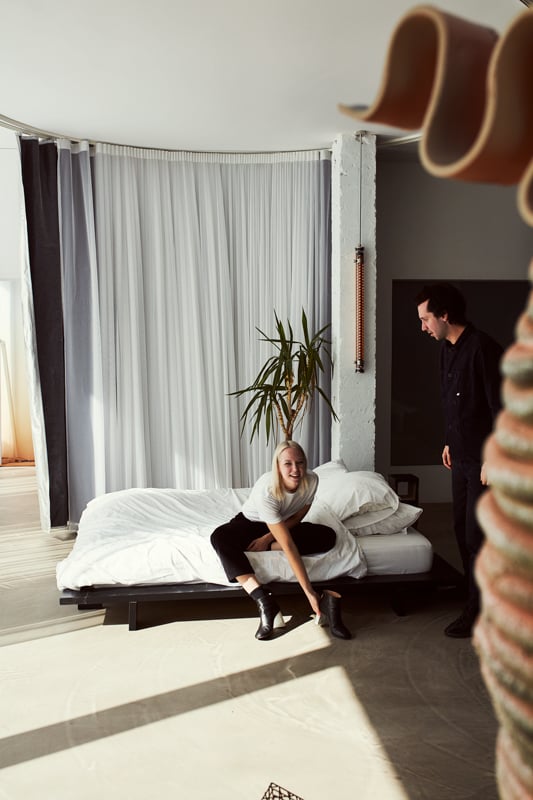
I wanted to talk with Sabine about her work and also meet her boyfriend, Paul. He’s an architect at OMA. Sabine has been collaborating with them lately on big projects like KaDeWe, in Berlin, or the Repossi shop, in Paris. They’ve both just finished a big project and have a quiet week, so we’re able to talk for hours over a bottle of wine and a lot of sushi at the new home they’ve built together.
I slept in the guest room they used as their home while they did all the renovations, and in the morning when I wake up it’s sunny and everything looks different. The sky is blue, with some Magritte-like clouds floating around. The light streams into the house and bounces over Sabine’s colourful furniture. My room overlooks a big canal where small cargo boats sail in and out, and some swans are swimming right in front of the house. I can project myself sitting there in summer, when the sunsets last forever (or at least well into the night). It could be paradise if only it wasn’t freezing.
How did you end up here?
Sabine: I never had a plan. Everything just happened by luck. I graduated, and then I didn’t want to work for anyone, so I just moved here. I got a super cheap house, because that’s what you can do in Rotterdam. Do you know this thing, antrikraak?
No.
Sabine: You can legally squat empty buildings in Holland.
Like Camelot?
Sabine: Yes! There’s even a company called Camelot here that organises it. Anyway, I moved here and got this antique clock house, which means I had an entire house to myself for 150 euros.
How did you know of this thing?
Paul: It’s quite common here. Especially when you’re a student and you have no money, that’s the thing everyone does.
Sabine: But you have to be lucky to get one, because there are a lot of people on the waiting list. Basically you occupy the place, so that no one can come and squat it. The only downside is that they can kick you out within a month. Before getting this place, I lived in five different antikraak houses, because they kept kicking you out after eight months.
You’ve both lived in an antikraak house?
Paul: Yes. It’s quite common.
Sabine: We would have never been able to buy this place if we hadn’t done that; it helps you save so much money.
So I came to Rotterdam, got one of these antikraak houses, and I was like, ‘Now I’m going to be a designer’. I also got a really cheap studio.
Your current one?
Sabine: No. We’re going to move out of that one. It’s too small now.
But you have the factory there.
Sabine: Yes, but even that’s too small now as well, because we’re doing bigger and bigger projects.
You’re moving out together? You and the factory?
Sabine: We work together. I would never get the same thing made by someone else.
The fact they’re small is the end of the road for you? If they cannot produce bigger, or more stuff?
Sabine: No. That’s why we’re scaling up. I think it’s super important to create a sort of community with the people you work with. Otherwise all the thinking that we’ve put in, they can just do it with another designer, or I can just go to another factory. But I think that’s not really a nice way to work.
So how did you start?
Sabine: When I first moved to Rotterdam, I got super lucky because I met this Danish artist, Fos—Thomas Fosen. While I was studying, I did quite a lot of freelance work for friends who are artists or fashion designers, to translate their wild ideas into feasible things. I did some work for a fashion designer friend to 3D print shoes. I really like the whole production process. Through friends of friends, Fos had a huge project for a big fashion brand to design all the interiors. He’s an artist, so he’s a bit out there.
Then I helped him to produce one small thing and it snowballed into me being his right hand, just figuring everything out with him and then producing everything. I did that for a few years, and then slowly started doing my own stuff on the side and then less for him and more of my own stuff. Then for some reason I’ve been doing a lot of projects with fashion houses. And in the last year, I’ve been doing way more architectural projects, too.
Yes, I was going to say. Because, until now, it’s been more about objects rather than spaces.
Sabine: Because I’m trained as an object designer or product designer, that’s always the way that my work has been applied. At the core of everything I do is the mix of a production process and a material. I explore a material, find out what else can be done with it, and how it can be pushed further. Then the result can become an object, but actually, it can also become many other things. Now I realise that because we work from a method and a material, the result can be any scale.
Do you start by finding somebody who can do something—like the glass you work with, which is quite specific—and then think of things to do with that, or is it the other way around?
Sabine: It definitely starts with the material. But pretty much everything I design is always produced either in Rotterdam or just around it.
Why do you think Rotterdam is a place where you can find these things? I mean, the right artisans and industrial producers?
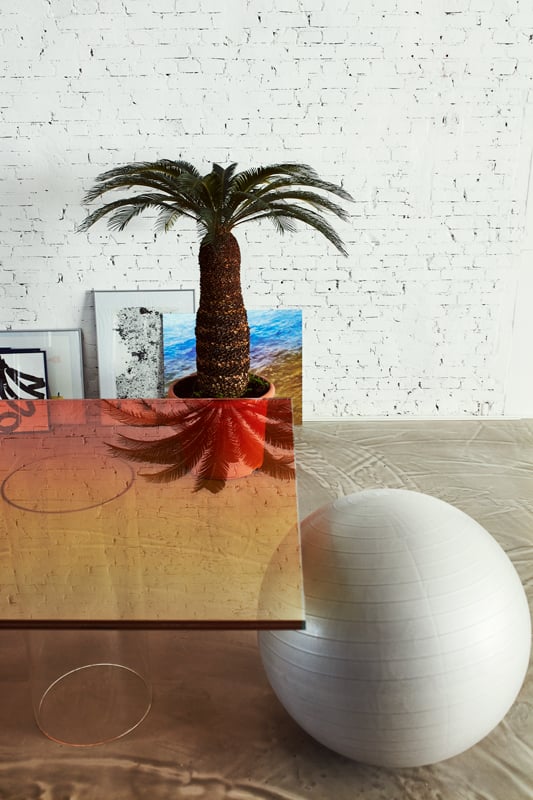
Sabine: I think because Rotterdam is a harbour, there’s a lot of industry around. Also, the main reason I’ve been able to work like this, especially with a glass company that is quite a boring company in itself, is because the owners are really open to experimenting and get super excited about it. It’s totally a personal thing.
Do they get back from you as much as you get from them?
Sabine: Totally. I think the only good collaborations are when you have completely different skill sets. They have so much knowledge of something that I have no knowledge of, but I come in with a completely different angle to a problem, or I think about using the machines in a particular way. The might say, ‘We can’t do that’. And I go, ‘Yes, but let’s try’.
I bet you were annoying at the beginning, but now you two are doing things much bigger than what they did before.
Sabine: Yes. Now we’ve done the entrance of KaDeWe.
I love that place!
Sabine: I haven’t seen it yet in real life.
Paul: We should go this summer.
Yes. It’s very conservative, but cool. At the top, there’s a food court and markets and restaurants—the best pretzels, the best sausages. It’s super German and huge, it’s like paradise in Berlin. The building is like this Nazi ministry—but fantastic. Did you work on the renovation of it?
Sabine: OMA did the renovation.
Paul: It’s quite a thing because, basically, the store needs to stay open. Every year they will do one section of the renovation, but it will take five years to happen.
It just started?
Paul: It started already with the ground floor. We did the shop window in the main entrance, and for the main entrance Sabine did these glass panels.
Sabine: I think it’s nice to keep working within different fields. It’s really cool to be involved in architectural projects, even though I’m totally not trained as an architect.
Paul: I don’t think you need to be. For a company like OMA, for instance, that’s precisely what’s super attractive. The fact that you can collaborate with people who bring you completely different perspectives on spaces.
Sabine: True.
Yes. Sabine, again you’re lucky to—not every architect would understand this way of working.
Sabine: Same as with the glass. You just need someone within a company who’s equally as enthusiastic about trying something different.
But when a big company like OMA trusts me I’m like, ‘Who am I at the end of the day to suggest how to work with different materials?’
By the way, what do you do at OMA, Paul?
Paul: Well, I’m an architect.
Sabine: Making coffee.
Must be good coffee.
Paul: I’m the only one who knows how to reset the printer.
Sorry, what I mean is, in a big company, work must be quite compartmentalised.
Paul: Well, we are a traditional architectural company, we can go from a concept to, let’s say, giving the key to the client. But next to that, we have this entity that is called AMO where we do research-based projects. It can be graphic design, it can be scenography, it can be curatorial projects for museums, it can be a strategy for brands, research for an institute, fashion shows, identity—anything, really anything. I’m trying as much as possible to do 50/50 between traditional architecture and unconventional architecture.
So it’s not completely separated into two companies?
Paul: No, totally not. It’s really based on the project. Sometimes I’m OMA, sometimes I’m AMO. You work on a photoshoot one day, the next day you work on editorial, the next day you do graphic design. This allows us to sometimes start with research and end up with the building, or to start from research and end up with something else in the building, which could be an exhibition or a publication. We also work with schools on educational programs and so on. You make your own path. Some people, they just want to work on buildings; some people are more into construction and only follow the construction phases of a building.
Many architects today get rid of the construction part.
Sabine: Actually, there are also many designers that design something, sketch it, do the technical drawing, and send it off. I wouldn’t want to work like that. I want to be in the factory to see what’s happening and do the colour test myself. There definitely has to be an element of handling. Also, it’s risky because your name is still on it and it may be executed badly.
You definitely prefer the idea space?
Paul: I’m definitely more on the conceptual side, I would say. When I joined the office, there were people who are still today, seven years later, working on the same building. That’s very architectural, it’s very slow. When we work on the AMO side, it can be much faster: one day you develop a concept, and the next week it’s built.
Sabine: To me, half a year is already long. I’d be like, ‘When is the end?!’ When I work for fashion brands, the deadline’s absurd. Things that would take three weeks happen over a weekend. But I like it, too, because you also find a way to make the impossible happen. It’s like, ‘Alright. I can do this, yes’.
It’s more about performing. Like, you have four days, what’s the best you can do in four days?
It’s totally like a performance sport. You get the adrenaline from it, too.
Is it the first time you’ve lived together in a common house?
Paul: No. We lived together because of antikraak. Sabine was kicked out of her place.
So she moved into yours?
Paul: Yes, but then we got kicked out of mine, too, and that’s how we started to look for a place to buy, somewhere we could live together. And then we found this thing.
Sabine: We weren’t looking to get something like this, we were just looking for a normal place. The thing with Rotterdam is, because it got completely bombed in the war, most of the houses are exactly the same. Then we were with the real estate agent and it was like, ‘Fuck. Don’t you have something a bit crazy? Paul’s an architect, I’m a designer, we can do stuff to a house’. We got lucky because the real estate guy had bought the floor above this one.
Himself?
Sabine: The company that he was working for. They had started developing the space into nice lofts. They just purchased this whole floor to be able to make the cabling go down from those places, but they didn’t have time to do anything with this floor. He said, ‘If you want to take it off our hands in the meantime, that’s fine. But it’s all or nothing, so you have to take everything or not’. We then went in and had a look. We were like, ‘What are we going to do? We can’t afford this’.
And you made three apartments out of the space?
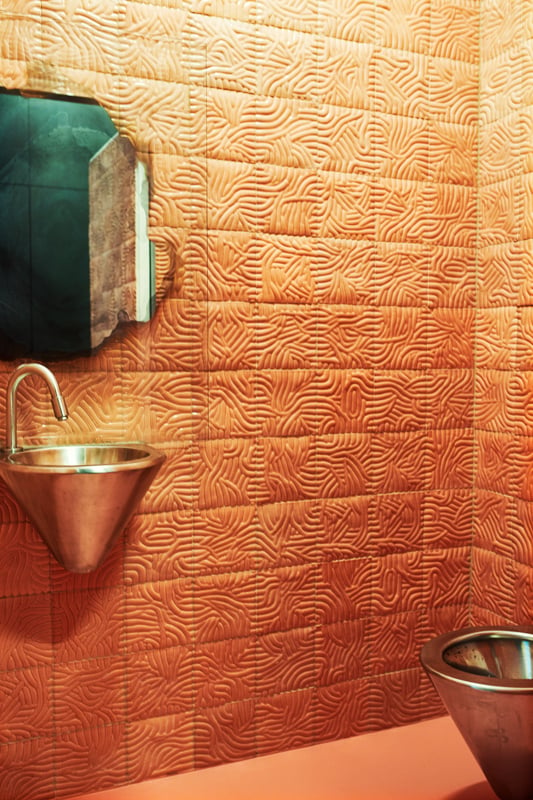
Sabine: Yes, they’re very different projects though, because for this side we wanted things that we really loved and other people probably would not, like the toilet tiles. For the other two apartments, we really had to think like, ‘What is generally accepted in a house?’ You go couch shopping for a couch you don’t really like, but that you expect a renter will like.
You got it quite fast. Where were you living in the meantime?
Paul: When we got kicked out we stayed at our friend’s place for a bit, while the guys were working here, until we could have a little room to be in while they finished the rest.
Sabine: We just had a piece of fabric over the door frame. Every morning it was super dusty.
Memories for life.
Sabine: So romantic. When we first started there was a lot of asbestos. They had to take all the ceilings down and then we had—I don’t know if that’s clever to mention this if it’s printed.
Paul: What?
What?
Sabine: The fire!
Paul: We had workers. Paid workers!
Sabine: They’re definitely paid. But it was part of the deal that the owner we bought it from would get rid of the asbestos. Then we still had to demolish a lot of other things. And then we would just work with these dudes that were a bit cowboy.
Paul: They were Hungarian cowboys.
Sabine: We were going to take photos of the place before the work with a photographer friend of ours, so we were driving here to meet her. This is a dead-end street, so we were at the beginning of the street and there was a cop car with sirens behind us. I was like, ‘Fuck’. We pulled over, but he just went straight past us down the street. It was like, ‘Oh. Phew. Not me’. Then we thought, ‘Hang on. What’s going on? It’s a dead-end street’. We were driving closer and closer to our house, then we saw smoke coming out of these windows. I so vividly remember thinking, ‘My life is over’. You could even see open flames coming out of the windows.
Really?
Sabine: Yes. Total fire. The guy who was doing the demolition was also in that same window looking out.
Paul: He was looking out through the window, you know?
Sabine: Real chill. There were all these people on the street. We were like, ‘What the fuck’s going on?’ Paul stopped the car in the middle of the street, and we both ran out. There was a firetruck, but our car was blocking the street. It was like, ‘Boop, boop’. It was this big drama. In the end, it turned out the guys had made a fire in a barrel to stay warm.
They were happy smoking and doing their thing.
Paul: They were like, ‘Yes, see you tomorrow’. We’re like, ‘What the fuck’.
I’m surprised they didn’t shut down the works.
Sabine: We were really, super lucky. We had loads of things stolen from the building site as well, like lead and machinery.
Paul: You’d come one day and they’d have ripped the pipes off the walls.
Sabine: That’s also Rotterdam. It’s a bit rough, but I think that’s what is super cool about Rotterdam. It has this roughness, but people just do their own thing.
How was it doing the house together? Did you have to negotiate a lot?
Sabine: No.
No? You have more or less the same taste?
Paul: No.
Sabine: No, but it was surprisingly easy.
It can be a couple-breaker.
Paul: Also we’d known each other for five years. At some point, you fade into each other.
Yes, true. That’s the process of life, but making a house must be the final process of bonding together. You both feel like the house represents you, right?
Sabine: I think if there were a client tomorrow that asked me to design his house and gave me complete carte blanche, I would never do this for another client. In that way it doesn’t represent my work. It does represent how I want to live and what I want to surround myself with.
As a designer who designs for people, this is not representative because you would never do this for someone else.
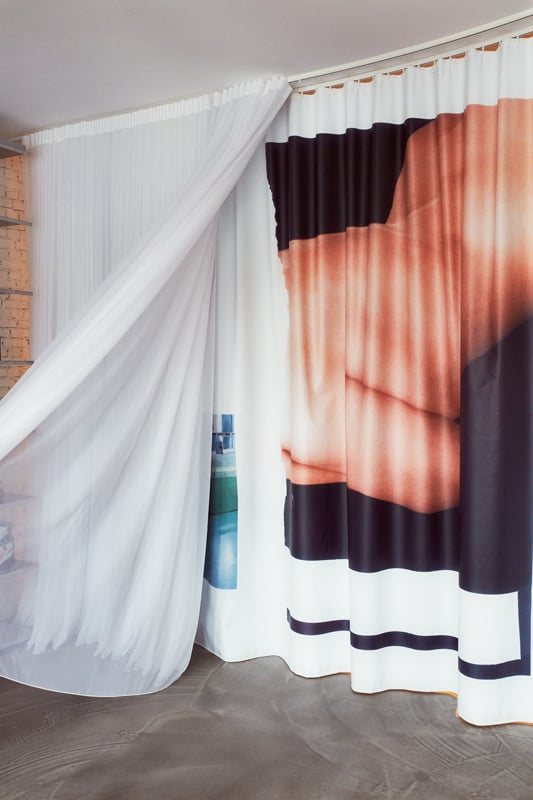
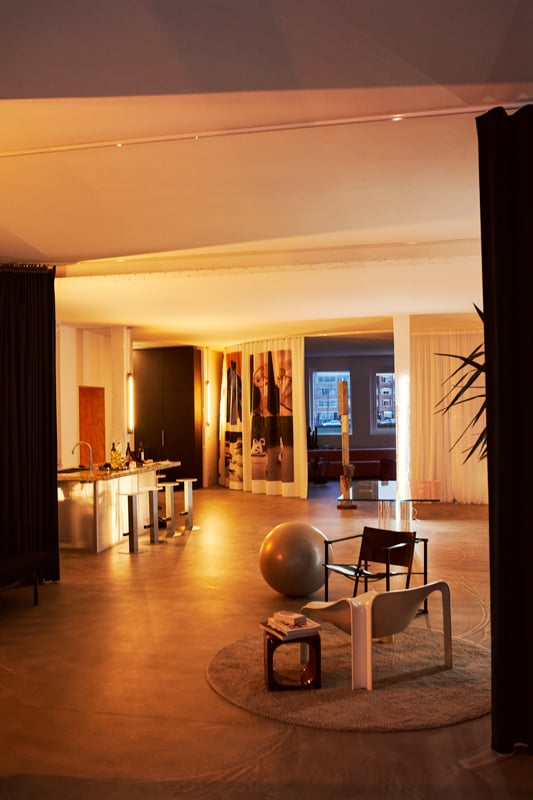
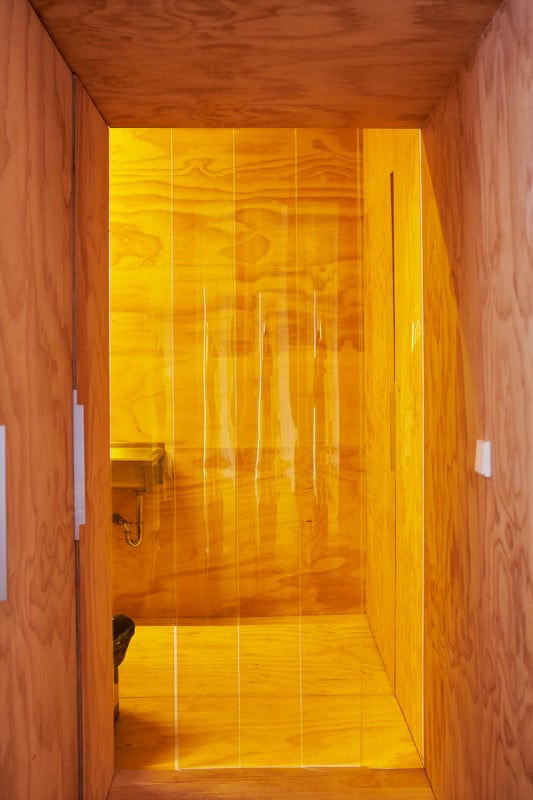
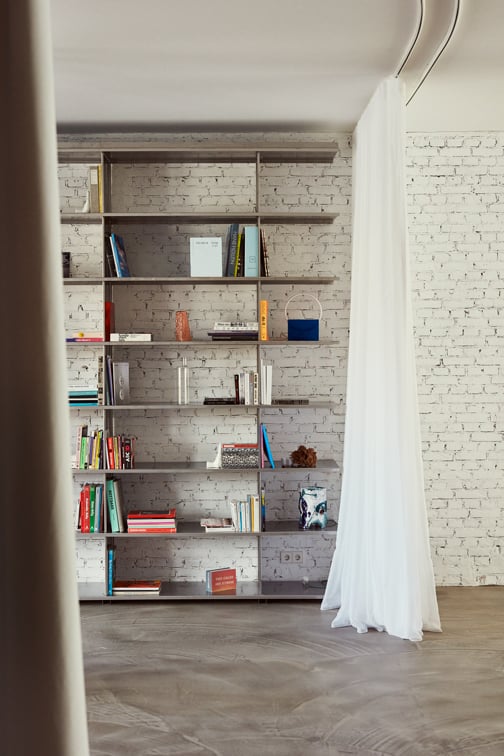
Sabine: I think it’s very personal. I don’t think a lot of people would want a massive window in their bathroom or those tiles in the toilet or no walls.
Paul: We had a lot of people asking, ‘But where’s your bedroom?’ And we’re telling them that the bed was just here. People were like, ‘That’s temporary, right?’ Like, ‘No. That’s our bedroom’.
Sabine: Also because we’re young and we don’t have shitloads of money; we worked with quite an affordable contractor. Some details are not what they should be, but you just have to look through it.
It’s not perfect-perfect.
Sabine: In my work, everything has to be perfect. In the house, not everything is perfect. But I think that’s also been a good learning curve. There are bigger problems in the world than one joint not lining up with another, don’t you think?
Paul: Yes. It’s been more like an accumulation of ideas that collide and become the space.
We didn’t really start drawing a straight line, saying, ‘We’re going to do this there’. It’s through time; it’s the luxury of being a designer, in the large sense, and also the client. You have the time.
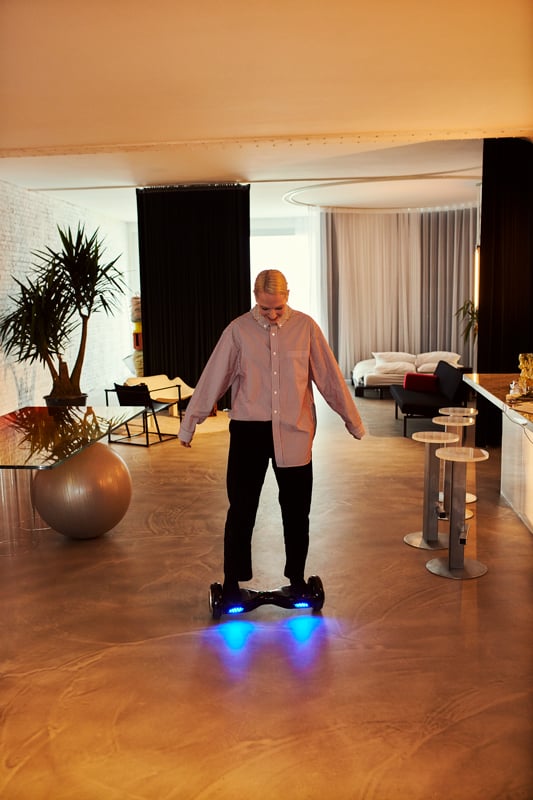
Sabine: To change. Actually, when you say it like that, it does represent the way that I, at least, like to work. The space is flexible. It could be done for a party, but also it could be a more intimate space, and then there’s the fact that all our friends have ended up being part of it.
I was surprised because I’d thought it would be more of a showroom for you.
Sabine: Yes, but I don’t want that. I see my work all day long.
But in the end, this is the first house that you’ve done for yourself.
Sabine: Neither of us have our families living in Holland, so it’s good to have a community of friends and I always like to include my friends in projects. There’s really this nice thing about being a crew of people working on one thing. Even though this is our house, we’ve had the same approach. All our friends have been part of making specific pieces for it. Now it’s not like, ‘Yay, my house is my work’. It’s like, ‘Yay and everyone else’s stuff in it as well’. I like the fact that it’s quite eclectic now. Even though it’s still quite empty.